
Scale is the decision that determines everything else in model collecting — the physical size of the finished piece, the level of detail legible at normal viewing distance, the display footprint required, and the price the quality of execution commands. It is also the decision that most new collectors make too quickly — defaulting to 1:72 because it is familiar, or 1:18 because it sounds impressive, without working through what the specific subject at that specific scale will actually look like in the specific space where it will be displayed. Getting the scale wrong does not ruin the model. It consistently produces a result that is slightly less than what the subject deserved — and slightly less than what the display context required.

This guide covers the most common scales across aircraft, automotive, and maritime subjects — what each scale delivers, what it trades away, and which subjects it suits best. Use it alongside the model scale calculator to determine the exact physical dimensions of any subject before ordering or commissioning.
Understanding Scale — What the Numbers Actually Mean
A scale ratio expresses the relationship between the model’s dimensions and the full-size subject’s dimensions. 1:48 means that one unit of measurement on the model corresponds to 48 units on the full-size original. A Spitfire with a 36-foot (11m) wingspan reproduced at 1:48 has a model wingspan of approximately 229mm — just under 23 centimetres. The same aircraft at 1:32 produces a wingspan of approximately 344mm. At 1:18, the wingspan exceeds 600mm — half a metre of model requiring dedicated display furniture.

The practical implication is that scale and subject size interact. A large subject at a small scale can produce a model too small to communicate the subject’s character. A small subject at a large scale can produce a model too large for the display space available. The collector who knows the full-size dimensions of their subject before selecting a scale makes a better decision than the one who selects scale first and calculates dimensions later.
Aircraft Scales — From Fleet Display to Statement Pieces
1:400 and 1:500 — Airliner Fleet Displays
Boeing 747 at 1:400 = 185mm length · Best for: airline livery collections, multi-aircraft fleet displays · Detail level: silhouette and livery accurate, surface detail minimal · Display footprint: minimal — suitable for desk or small shelf display
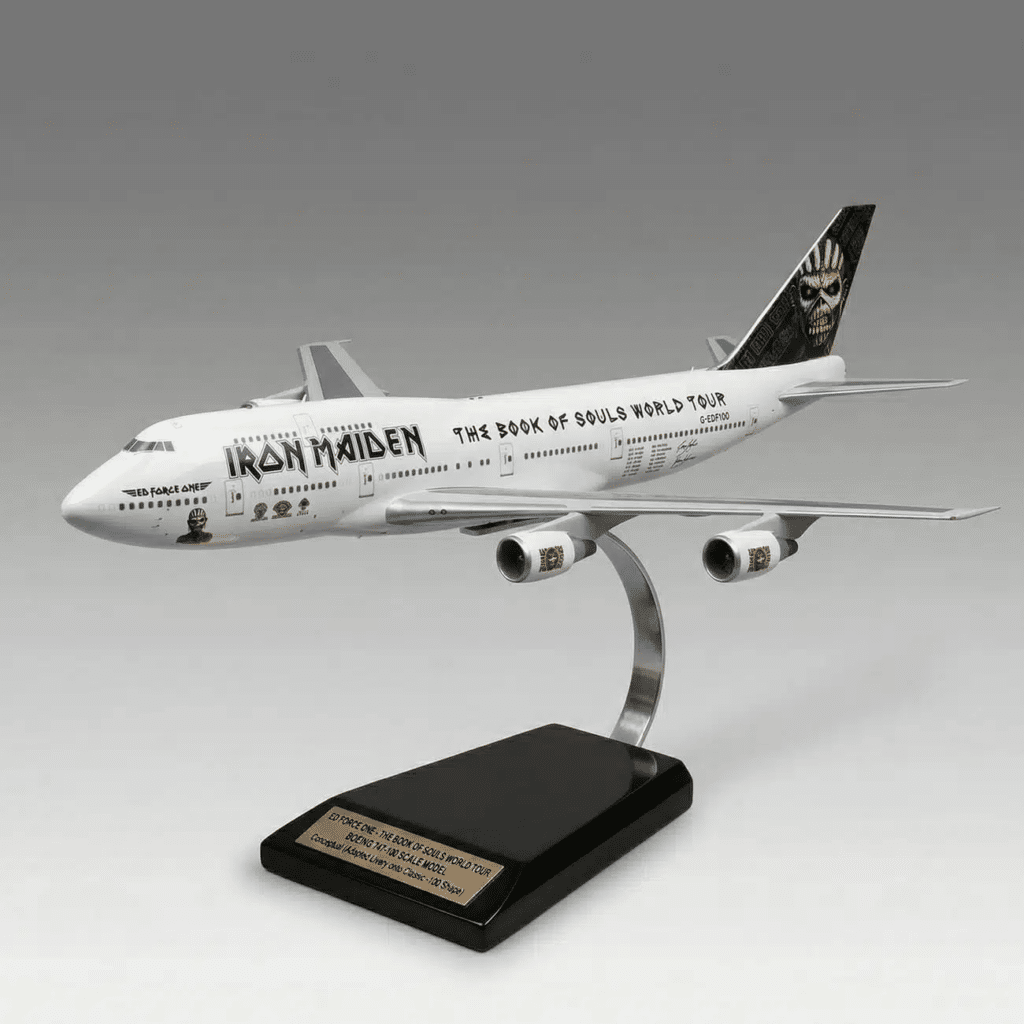
The smallest practical collector scales for commercial airliners. The primary value at these scales is subject range — the widest variety of airline liveries and aircraft types is available at 1:400 and 1:500 from specialist die-cast producers. Individual surface detail is minimal and cockpit interiors are absent. These scales suit collectors whose primary interest is livery documentation and fleet history rather than mechanical accuracy or surface detail.
1:144 and 1:200 — Commercial and Large Military Aircraft
Boeing 747 at 1:144 = 513mm length · B-52 at 1:144 = 700mm wingspan · Best for: large commercial airliners, heavy bombers, wide-body display pieces · Detail level: livery and major surface features accurate, cockpit present but not detailed
The practical scales for large scale planes that would be unmanageably large at higher scales. A Boeing 747 at 1:144 produces a 513mm model — a substantial desk piece that communicates the aircraft’s proportions clearly. Heavy bombers and very large military aircraft are generally most practical at 1:144. Wide-body commercial airliners in airline livery at 1:200 are the most widely collected scale in the serious aviation market — the range of subjects available at 1:200 from quality producers is the broadest of any scale in the commercial aviation category.
1:72 and 1:48 — The Serious Collector Standard
Spitfire at 1:72 = 152mm wingspan · Spitfire at 1:48 = 228mm wingspan · Best for: WW2 fighters, jet age fighters, most single and twin-engine military subjects · Detail level: surface detail, cockpit interior, markings all fully accurate and legible
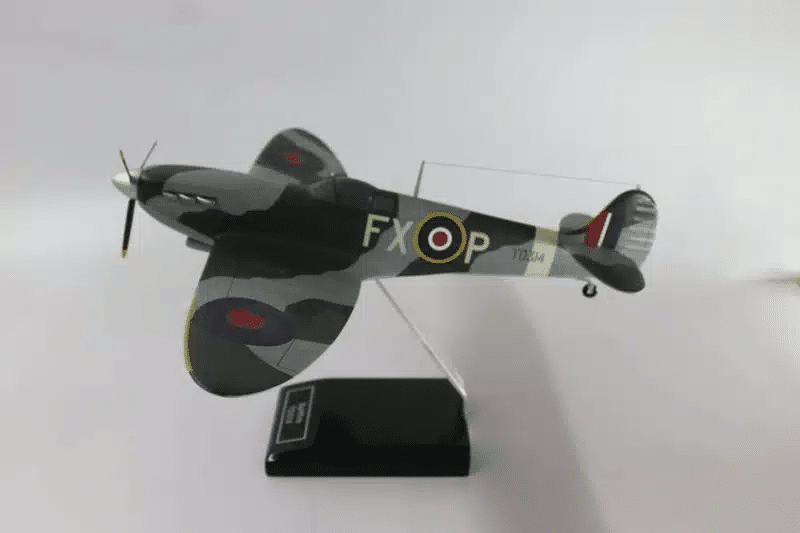
The scales at which surface detail, cockpit configuration, and marking accuracy become fully legible at arm’s length. 1:72 is the most widely produced scale in the plastic kit market — the subject range is the broadest of any aviation scale, and the display footprint is manageable for multi-aircraft displays. 1:48 produces models with noticeably more presence and detail legibility, and is the preferred scale for serious display collectors who want the maximum accuracy from a single subject at a manageable display size. The difference between a quality 1:48 and a quality 1:72 of the same subject is immediately apparent to anyone who examines both at arm’s length.
1:32 and 1:24 — Statement Display Pieces
Spitfire at 1:32 = 343mm wingspan · F-14 Tomcat at 1:32 = 580mm wingspan · Best for: single statement pieces, commissioned replicas, display subjects where detail is the primary value · Detail level: maximum — rivets, fabric surface texture, cockpit detail fully legible
At 1:32 and above, the model transitions from a collector piece to a display object whose physical presence communicates the aircraft’s character in a way smaller scales approximate but cannot match. The rivet detail on a 1:32 Spitfire is legible without magnification. The fabric texture of the control surfaces can be reproduced with the individual stitch pattern visible at arm’s length. The cockpit interior is large enough for accurate instrument reproduction that a pilot would recognise from operational experience. These scales suit single statement subjects rather than multi-aircraft displays — the footprint demands dedicated space, but the result justifies it.
Automotive Scales — Cars and Trucks
1:64 and 1:43 — Compact Collection Scales
Ferrari 250 GTO at 1:43 = 103mm length · Best for: large collections, multi-subject displays, motorsport livery documentation · Detail level: silhouette and colour accurate, opening components absent at most price points

The most widely collected automotive scales in terms of subject range. The 1:43 market — served by manufacturers including Minichamps, Spark, and IXO — is the broadest single scale in automotive collecting, encompassing road cars, racing cars, trucks, and commercial vehicles across every era and nationality. The compact size makes multi-subject displays manageable on standard shelving. For collectors building comprehensive coverage of a marque, era, or racing series, 1:43 is the standard scale that the most complete collections use.
1:18 — The Display Standard
Ferrari 250 GTO at 1:18 = 247mm length · Best for: single-subject display pieces, opening component detail, interior accuracy · Detail level: highest in production market — opening doors, bonnet, boot; engine detail; interior fully reproduced
The 1:18 scale is the serious automotive collector’s default for statement display pieces — large enough for opening components, interior detail, and engine bay accuracy to reward close examination, compact enough for desk or shelf display without requiring architectural space. The miniature car dealer and collector market at 1:18 is served by the highest quality production die-cast from Autoart, CMC, and Kyosho — manufacturers whose 1:18 pieces represent the ceiling of what production model making can deliver before commissioned hand-built pieces take over.
1:12 and Larger — Commission and Premium Scale
Ferrari 250 GTO at 1:12 = 370mm length · Best for: flagship statement pieces, commissioned replicas, institutional display · Detail level: hand-built quality — surface finish, leather interior, engine detail all at maximum fidelity
At 1:12 and above, the automotive model enters territory where production catalogue pieces become rare and hand-built commissions dominate. The miniature toy cars term does not apply here — at this scale, a 1:12 Ferrari 250 GTO is 370mm long and requires the same display consideration as a decorative sculpture. The market for this scale is small, serious, and demanding: collectors who want the maximum possible fidelity from their primary subject, at a scale where the craftsmanship of the maker is as legible as the design of the original.
Maritime Scales — Ships, Yachts, and Boats
Maritime model scales follow a different convention from aviation and automotive — the range is wider, the subjects are more varied in size, and the collecting tradition is older and less standardised. A tall ship replica and a working harbour tugboat operate in entirely different scale frameworks even for the same physical display size, because the full-size subjects differ so dramatically in length.
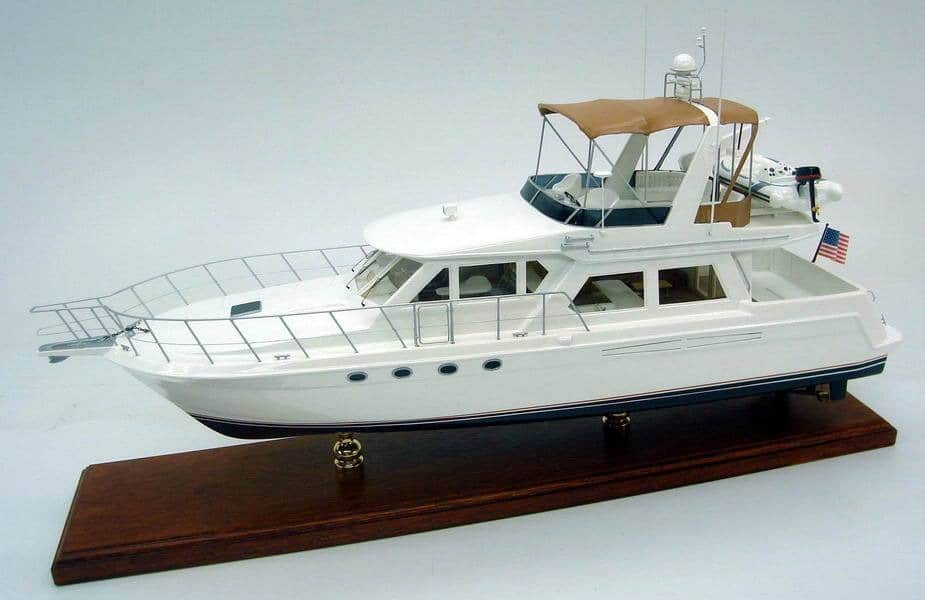
For boat models, the most important scale consideration is the relationship between the hull length of the full-size vessel and the display length of the finished model. A sailing yacht of 12 metres reproduced at 1:50 produces a model of 240mm — a compact desk piece. The same yacht at 1:25 produces a 480mm model requiring dedicated display space. Commercial vessels — tankers, container ships, naval vessels — that run to 200 metres or more at full size are typically reproduced at 1:700 or 1:1200 for manageable display, or at 1:350 for museum-quality detailed replicas. For the collector commissioning a specific named vessel, calculating the display dimensions at the intended scale before briefing the maker is the single most useful preparation step available.
Calculate the physical dimensions of your subject at your intended scale before you order or commission. The scale that looks right on paper and the scale that works in the display space are not always the same number.
Frequently Asked Questions
What does model in scale mean?
A model in scale is a three-dimensional replica of a full-size subject reproduced at a fixed proportional ratio — so that every dimension of the model bears the same relationship to the corresponding dimension of the original. A 1:48 model in scale is 48 times smaller than the original in every dimension: length, width, and height. Scale consistency means that two different subjects reproduced at the same scale can be displayed together with their size relationship accurately representing the size relationship of the full-size originals.
How do I calculate the size of a model at a specific scale?
Divide the full-size dimension by the scale ratio. A Boeing 747 with a 68-metre wingspan at 1:144 scale: 68,000mm ÷ 144 = 472mm model wingspan. For quick calculation across multiple subjects and scales, use the model scale calculator which handles the arithmetic and displays the result in the units most useful for display planning.
What is the most popular scale for model aircraft?
1:72 is the most widely produced scale for plastic kit aircraft models, with the broadest subject range of any aviation scale. 1:48 is the preferred scale for serious display collectors wanting maximum detail at a manageable size. 1:200 is the dominant scale in the commercial airliner die-cast market. 1:32 is the scale of choice for commissioned and premium hand-built display pieces where surface detail and cockpit accuracy are the primary values. The right scale depends on the subject, the display context, and whether the collector’s primary value is subject range or individual piece quality.
The Scale That Suits the Subject — Not the Other Way Around
The most common scale selection mistake is choosing a scale and then finding a subject to fill it. The correct sequence is the reverse: choose the subject whose historical, personal, or aesthetic significance justifies acquisition — then determine which scale communicates that significance most effectively in the display context available. The scale serves the subject. The subject determines what the scale needs to deliver. Working in that order produces a collection where every piece is at the scale it deserves rather than the scale that happened to be convenient when the decision was made.
Use the scale calculator. Measure the shelf before you commission. And choose the scale that makes the subject what it should be — not the one that fits the space that was left over.