

Military aircraft are the most consistently collected scale model subjects in aviation history — and for reasons that go well beyond the obvious appeal of combat machines. Fighter jets and WW2 planes represent aviation at its most uncompromised: designs driven entirely by the requirement to outperform an adversary in a specific set of flight conditions, with no accommodation for commercial cost pressures, passenger comfort, or regulatory compliance. Every design decision was a performance decision. Every surface exists because it was required. The result is objects of extraordinary design clarity — and scale models that, when accurately executed, communicate that clarity at arm’s length as effectively as the full-size aircraft does from the flight line.

Why Military Aircraft Are the Most Compelling Scale Subjects
The collecting appeal of military aircraft operates on two levels simultaneously. The historical level is straightforward: these are the machines that determined the outcomes of conflicts, that defined the capabilities of nations, that produced the most intense periods of aviation engineering development in history. The WW2 period alone — six years during which piston engine technology was pushed to its absolute limits — produced a concentration of significant aircraft types that no comparable peacetime period has matched. The Spitfire, the Hurricane, the P-51 Mustang, the Fw 190, the Zero, the B-17: each is a complete argument about what a specific nation’s aviation industry was capable of producing under maximum pressure.
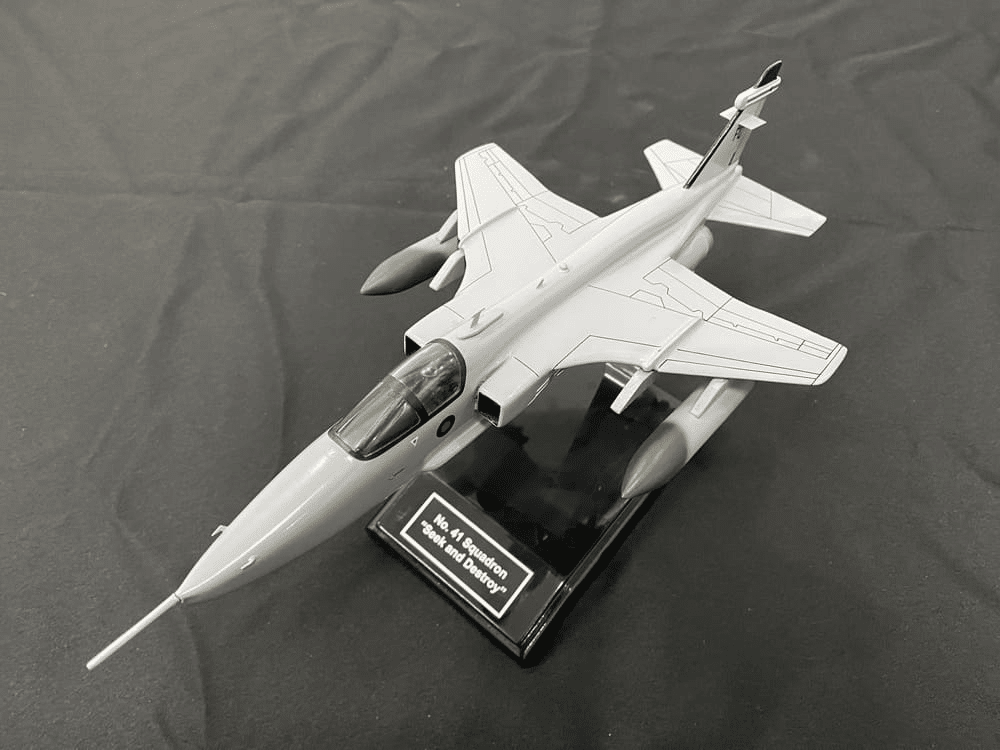
The second level is aesthetic — and here the military aircraft’s design-without-compromise philosophy produces its most direct collector appeal. The elliptical wing of the Spitfire, the bubble canopy of the P-51D, the twin-boom configuration of the P-38 Lightning — each of these design features is immediately recognisable because it is visually distinctive, and it is visually distinctive because it was the engineering solution to a specific performance problem rather than a styling choice. Necessity produced form. Form became identity. And identity, at scale, is what makes a display piece immediately legible from across a room.
WW2 Model Planes — The Subjects Worth Prioritising
Top WW2 collector subjects: Supermarine Spitfire · P-51D Mustang · Focke-Wulf Fw 190 · Mitsubishi A6M Zero · Boeing B-17 Flying Fortress · de Havilland Mosquito · Hawker Hurricane · Messerschmitt Bf 109
The WW2 model planes category divides naturally into single-seat fighters, twin-engine fighters and attack aircraft, and heavy bombers — three collecting sub-categories with different scale requirements and different display characteristics. Single-seat fighters at 1:32 or 1:48 produce the most detailed display pieces with cockpit interiors fully legible at arm’s length. The Spitfire’s narrow cockpit, the Mustang’s bubble canopy, and the Zero’s minimal instrumentation all read clearly at these scales in a way that 1:72 approximates and 1:144 cannot approach. Heavy bombers — the B-17, the Lancaster, the B-29 — require larger display footprints but reward the investment with physical presence that communicates the aircraft’s scale relationship to the fighters that escorted it.
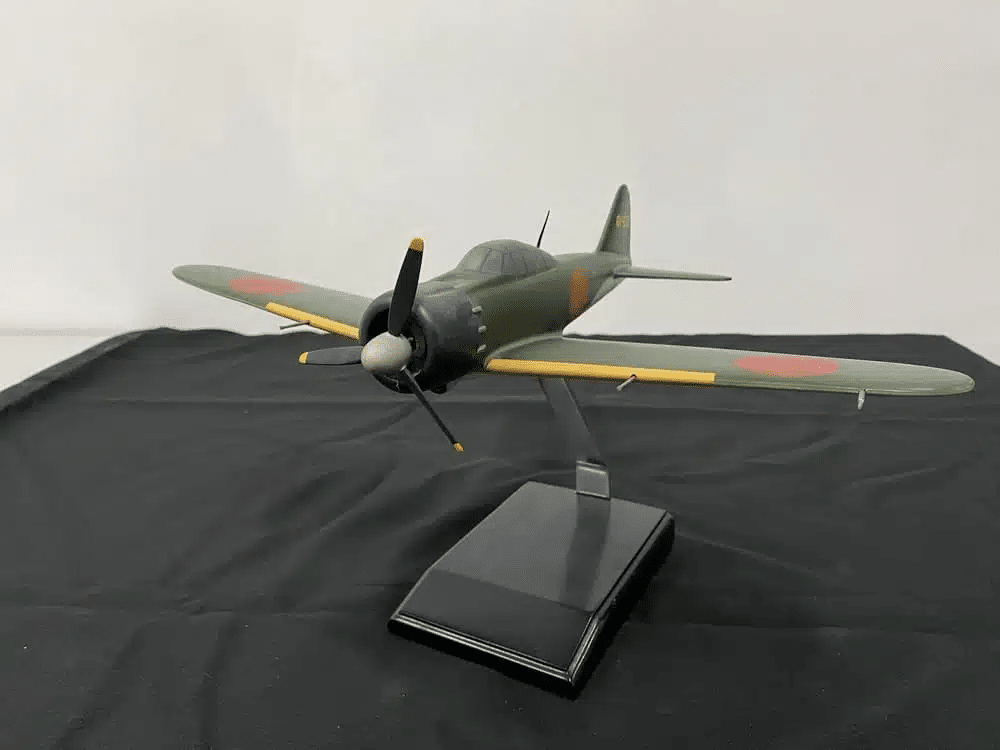
The most historically significant WW2 subjects carry additional weight beyond their design quality: specific aircraft that flew specific missions, marked with the specific codes and nose art of their operational period, documented in enough detail that an accurate replica carries historical specificity rather than generic type representation. The Memphis Belle B-17 in its correct markings. The Spitfire of Douglas Bader’s 242 Squadron. The P-51D of Chuck Yeager’s 357th Fighter Group. These are not generically significant aircraft — they are specifically significant ones, and the replica that reproduces them accurately carries that specificity in a way that a generic type replica does not.
Model Fighter Jets — From the First Jets to the F-22 Raptor
Top jet age collector subjects: F-86 Sabre · MiG-15 · F-104 Starfighter · F-14 Tomcat · F-15 Eagle · Su-27 Flanker · F-22 Raptor · Eurofighter Typhoon · Lockheed F-117 Nighthawk
The jet age introduced a new aesthetic vocabulary to military aviation — swept wings, area rule fuselages, afterburner nozzles, and eventually the blended surfaces of stealth geometry that the F-117 and F-22 Raptor brought to production. Model fighter jets spanning the jet age tell the complete story of how aviation engineering responded to the challenge of supersonic flight — the design compromises that the sound barrier imposed, the solutions that different national aviation industries developed, and the eventual convergence on the blended wing-body configurations that define current generation fighters.
The Cold War fighter pairing — F-86 Sabre versus MiG-15 over Korea, F-14 Tomcat versus Su-27 Flanker across the Iron Curtain, F-15 Eagle versus MiG-29 Fulcrum in the late Cold War period — produces the most historically coherent collecting framework in the jet age category. Each pairing documents a specific chapter of the technological competition between American and Soviet aviation industries, and the two aircraft displayed together carry an adversarial context that either one alone cannot communicate. The display argument becomes more interesting when both sides of the conflict are present.
Large Scale Planes — When Size Changes the Display Entirely
Scale selection is the most consequential decision in the military aviation collecting process — and the decision that most collectors make too quickly. The standard argument for 1:72 is accessibility: wide subject range, manageable display footprint, lower price point. All of these are real advantages. But 1:72 consistently undersells the subjects it represents. A Spitfire at 1:72 produces a model of approximately 150mm wingspan — present on a shelf but not commanding it.

The same subject at 1:32 produces 340mm of wingspan with cockpit detail fully legible, fabric control surface texture reproduced at the stitching level, and a physical presence that makes the aircraft’s small size — the Spitfire’s cockpit was famously cramped — viscerally comprehensible in a way that the smaller scale cannot achieve. For large scale planes, the investment in a larger format consistently produces a display result that smaller scales approach but do not deliver.
The scale you choose determines what the model can communicate. A fighter at 1:72 represents the aircraft. The same subject at 1:32 begins to reproduce the experience of being near it — which is a different display result entirely.
What to Look For — and What to Avoid
The market for military aviation scale models spans a wide range — from low-cost production die-cast at 1:144 to hand-built commissions at 1:18 and above. The collector navigating this range for the first time should establish three criteria before looking at any specific piece: which subject, which scale, and what level of accuracy is required for the subject’s significance to be honestly communicated. A generic WW2 fighter at a budget price communicates something. A specific variant in specific markings at a quality level that honours the aircraft’s historical significance communicates considerably more. The distance between those two outcomes is the entire scope of the model aircraft collecting category — and knowing where on that range the right piece for a specific collection sits is the most useful thing any collector guide can help establish.
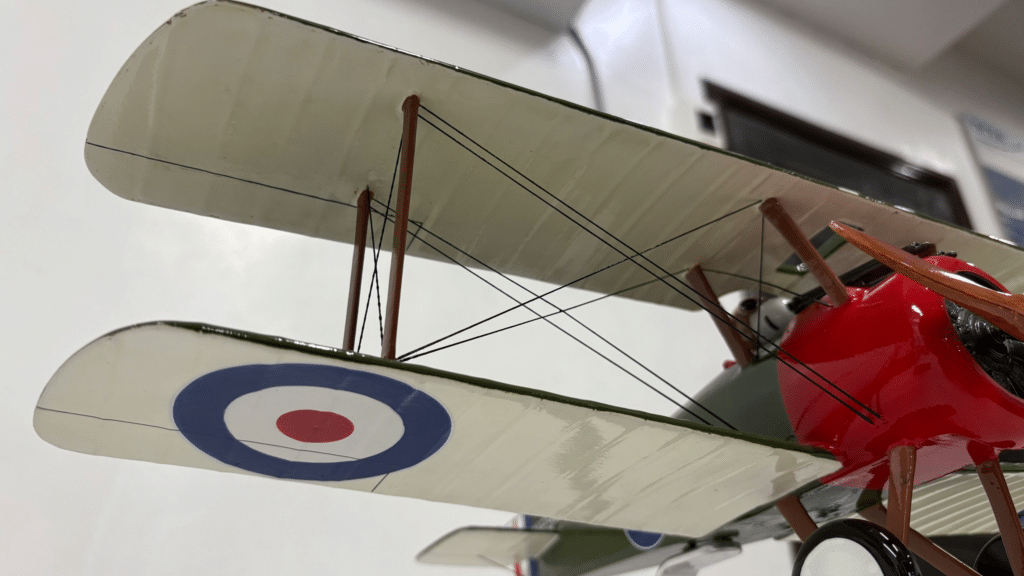
For subjects not available through standard production — specific markings, uncommon variants, or aircraft whose significance justifies a commission rather than a catalogue purchase — hand-built replicas produced to a specific brief deliver accuracy and subject specificity that no production piece can approach. Before commissioning, use the model scale calculator to determine the physical dimensions of your chosen subject at different scales — knowing the finished wingspan before ordering avoids the most common display planning mistake.
Frequently Asked Questions
What scale is best for WW2 model planes?
1:48 is the most widely recommended scale for WW2 single-seat fighters — it produces models of 200–250mm wingspan with cockpit detail fully legible at arm’s length, at a display footprint manageable on most shelves. 1:32 is preferred for statement display pieces where surface detail and cockpit accuracy are the primary values. 1:72 suits collectors building multi-aircraft displays where scale consistency across many subjects is more important than maximum detail on any single piece. For heavy bombers, 1:72 is typically the largest practical scale for home display.
Which WW2 model planes are the most collected?
The Supermarine Spitfire is consistently the most collected WW2 aircraft subject globally, followed by the P-51D Mustang and the Messerschmitt Bf 109. In the bomber category, the Boeing B-17 Flying Fortress and the Avro Lancaster are the dominant subjects. Japanese subjects — the Mitsubishi A6M Zero in particular — generate strong collector demand especially in the Asia-Pacific market. The de Havilland Mosquito is frequently cited by serious collectors as the most technically interesting and most undervalued WW2 subject in the standard production catalogue.
Are diecast airplane models worth collecting?
Quality die-cast military aviation models from reputable manufacturers — Corgi, Oxford Diecast, Hobby Master — represent good value at 1:72 and 1:144 for collectors building broad subject displays. The detail ceiling of die-cast production is lower than hand-built or resin cast alternatives at equivalent scales, but the subject range is wider and the price point more accessible. For collectors whose primary value is subject range and historical breadth rather than maximum accuracy at specific scales, a quality die-cast collection is entirely defensible. For subjects whose historical significance justifies maximum accuracy, commissioned or high-end resin pieces consistently produce better results.
The Aircraft Worth Preserving — and the Standard They Deserve
The military aircraft that defined aviation history were built to a standard of engineering rigour that their scale replicas should honour. The Spitfire was not designed to approximate the performance requirement. The F-22 was not engineered to be close enough to the stealth requirement. Both were pushed to the limits of what the engineering knowledge of their era could deliver — because the operational environment demanded nothing less. The scale model that represents them deserves the same commitment to accuracy that the original received in design and manufacture. Not perfection — but the same refusal to accept close enough when better is achievable.
That standard, applied consistently, produces a collection that honours what it displays. And a collection that honours what it displays is, in the end, the only kind worth building.