
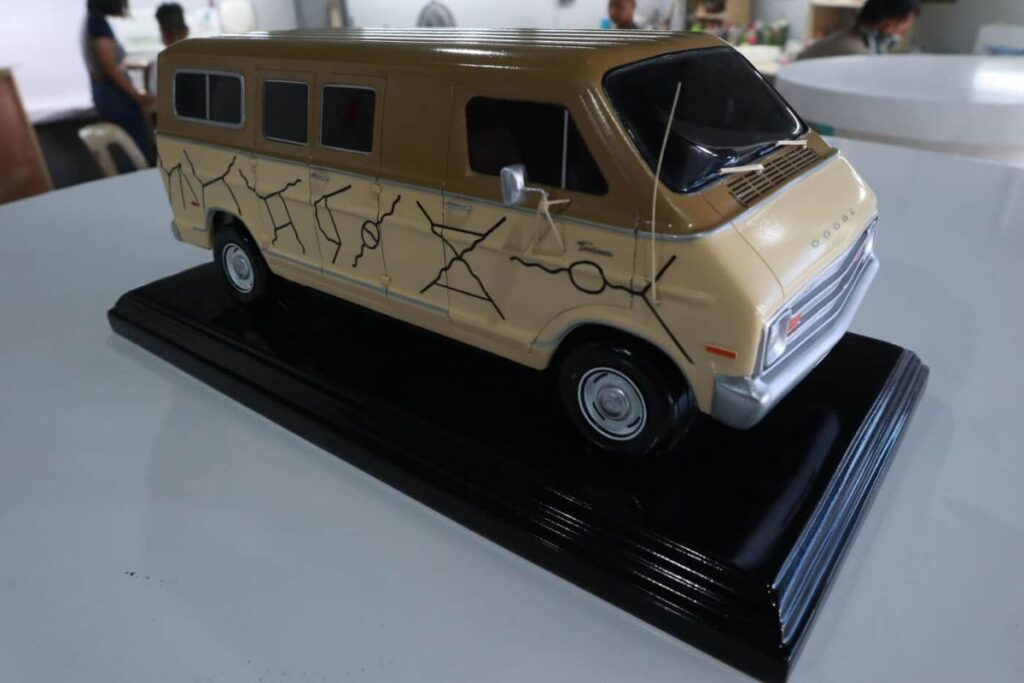
Walk into a hobby shop and the shelf shows where the mainstream stops: 1:18 and 1:24 for cars, 1:43 for the budget end, 1:64 for pocket money. A collector who wants to see the stitching on a seat, the weave of a wiring loom or the lettering on a tyre sidewall eventually runs out of shelf. That is where oversized replicas begin. This guide covers the real size of each scale in centimetres, how the hobby got to 1:8 and beyond, how many parts and hours sit inside the best models, what they cost, and how to display and choose one.
A note on the word “diecast”: it means zinc-alloy casting, and most of the history below is about cast models. The models we build at Modelworks Direct are different: hand-built from solid mahogany. They belong in the same conversation about size, so we cover both honestly.
How Big Is “Oversized”? The Scale Maths
A scale is a ratio: at 1:8, 8 units of the real car become 1 on the model. The table uses a car 4.5 metres long (a typical coupe or sedan; the figures are my arithmetic). The last column is the part people overlook: material and finishing work grow with the cube of the size, not the square.
| Scale | Length of a 4.5 m car | Linear size vs 1:18 | Material volume vs 1:18 |
|---|---|---|---|
| 1:43 | 10.5 cm | 0.4x | 0.1x |
| 1:24 | 18.8 cm | 0.75x | 0.4x |
| 1:18 | 25 cm | 1x | 1x |
| 1:12 | 37.5 cm | 1.5x | 3.4x |
| 1:8 | 56 cm | 2.25x | 11x |
| 1:6 | 75 cm | 3x | 27x |
| 1:4 | 112 cm | 4.5x | 91x |
Going from 1:18 to 1:8 makes the model 2.25 times longer, but it has about 5 times the paintable surface and about 11 times the volume. That is why price does not rise in step with length. A 90 mm headlight on the real car is 5 mm across at 1:18 and 11 mm at 1:8, large enough to build a lens, reflector and bezel as separate parts instead of one moulded blob. Our model scale calculator runs the same sums for any vehicle length, which matters because a 6 metre truck and a 3.6 metre city car at the same ratio end up very different sizes.
A Short History of Going Big
Large models predate the hobby. Wikipedia’s die-cast toy history dates the first mass-produced die-cast vehicles to the early 20th century, from Meccano’s Dinky Toys in the UK and Dowst Brothers’ Tootsietoy in the US. Dinky production began in 1934, Corgi followed in 1956 and Mattel launched Hot Wheels in 1968 at 1:64. All were made small and cheap on purpose.
The big end came from industry. Citroën was making promotional models by 1923, including 1/8 and 1/11 versions assembled from separate pieces because die-casting was not yet perfected. Car makers also modelled new designs in clay and wood at 1:4, 1:5, 3/8 and 1:10, sometimes full size, because designers judge proportion far better on a large object than a small one. Collectors later rediscovered the same truth: bigger shows more.
In 1966 Pocher showed a 1:8 Fiat F2 130HP, the 1907 French Grand Prix winner, at the Milan Toy Fair. According to Wikipedia’s Pocher entry, the kit used 144 plastic parts, 173 brass parts and 506 parts in steel, copper, leather, rubber and aluminium: 823 in total by my addition. Later Pocher kits went much further, with 2,378 parts in the Mercedes-Benz 500K/AK and 2,905 in the Rolls-Royce Phantom II Torpedo. Spoked wire wheels were assembled spoke by spoke, with threaded fasteners rather than glue, and finished cars reached up to 22 inches (560 mm) and 16 lb (7.3 kg). The company stopped in 2000, Hornby bought the brand in 2004, and a 1:8 Lamborghini Aventador kit followed in 2013.
Meanwhile the Franklin Mint entered die-cast cars in 1983 with a 1935 Mercedes-Benz 500K Roadster, mostly at 1:24, and 1:18 became the dominant US scale through the 1990s.
Parts, Hours and Prices: What You Pay For
Parts count is the quickest honest measure of how much work sits inside a model. Compare two 1:18 Mercedes 300 SL models. Norev’s model for Mercedes-Benz is 25.3 cm long, die-cast zinc with plastic parts, assembled from over 100 pieces. CMC’s hand-assembled all-metal 300 SL Roadster uses more than 1,050 parts, and its 300 SLR Coupé over 1,800 (see the CMC flyer). That is ten times the parts at the same size, and retail prices for CMC models run from several hundred to over a thousand dollars.
At 1:8 the numbers climb again. Amalgam Collection of Bristol, working from manufacturer CAD data, says in Ferrari’s own magazine that the master patterns for the SF90 Stradale model took 3,500 hours, the model has around 2,000 parts and each one needs about 350 hours to build and finish. Its Ferrari 250 GTO model needs 2,132 parts and its Mercedes-AMG ONE model 1,192 hand-made parts including castings, photo-etchings and CNC-machined metal, in an edition limited to 199 pieces at over 58 cm long. Motor Sport magazine reports 1:8 models starting around £8,495 and climbing above £20,000, against roughly £2,800 when Amalgam began selling them in volume around 2000.
For owners of unique, very high-value cars Amalgam also builds one-off 1:5 or 1:4 models. The pattern across makers is the same: at oversized scale you are paying for labour hours and tooling, not materials.
Cast vs Handcrafted: What Changes at Large Scale
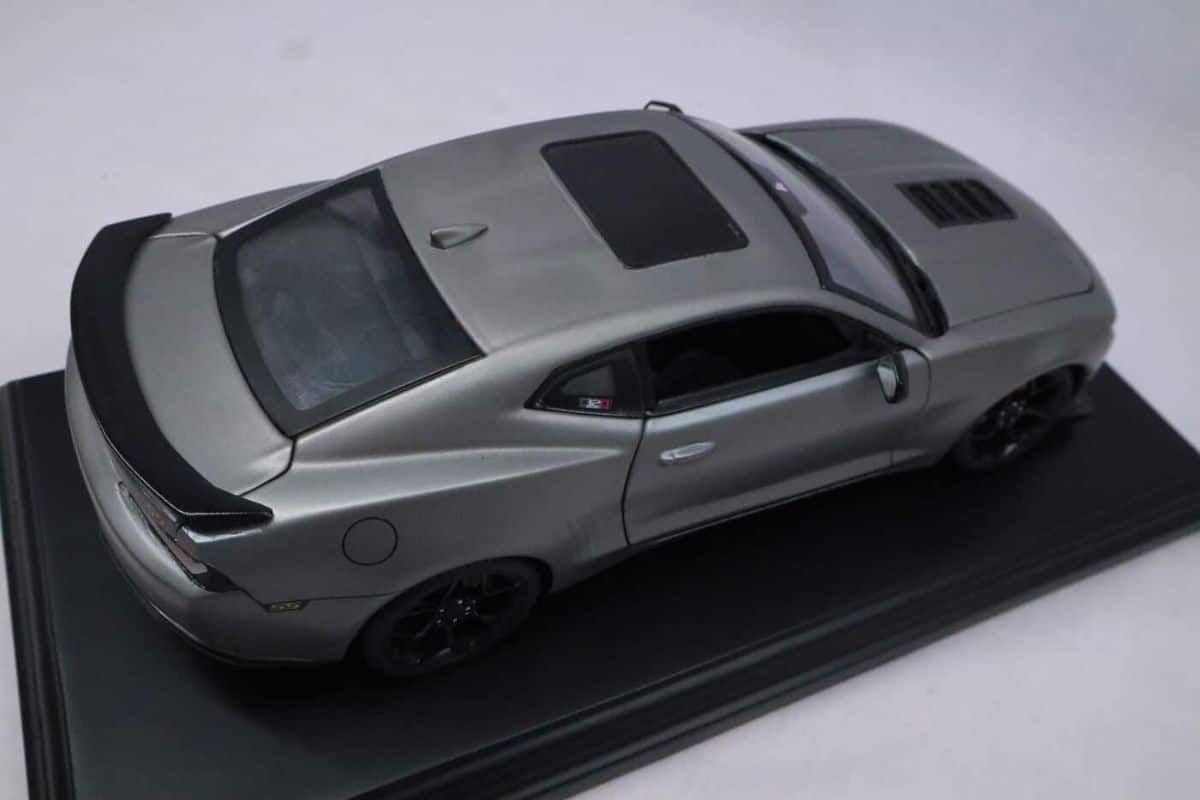
Casting pays off when thousands of identical pieces share the cost of a mould. That is why mass-market oversized diecast is limited to popular cars: if your subject is a one-off, the mould never pays back.
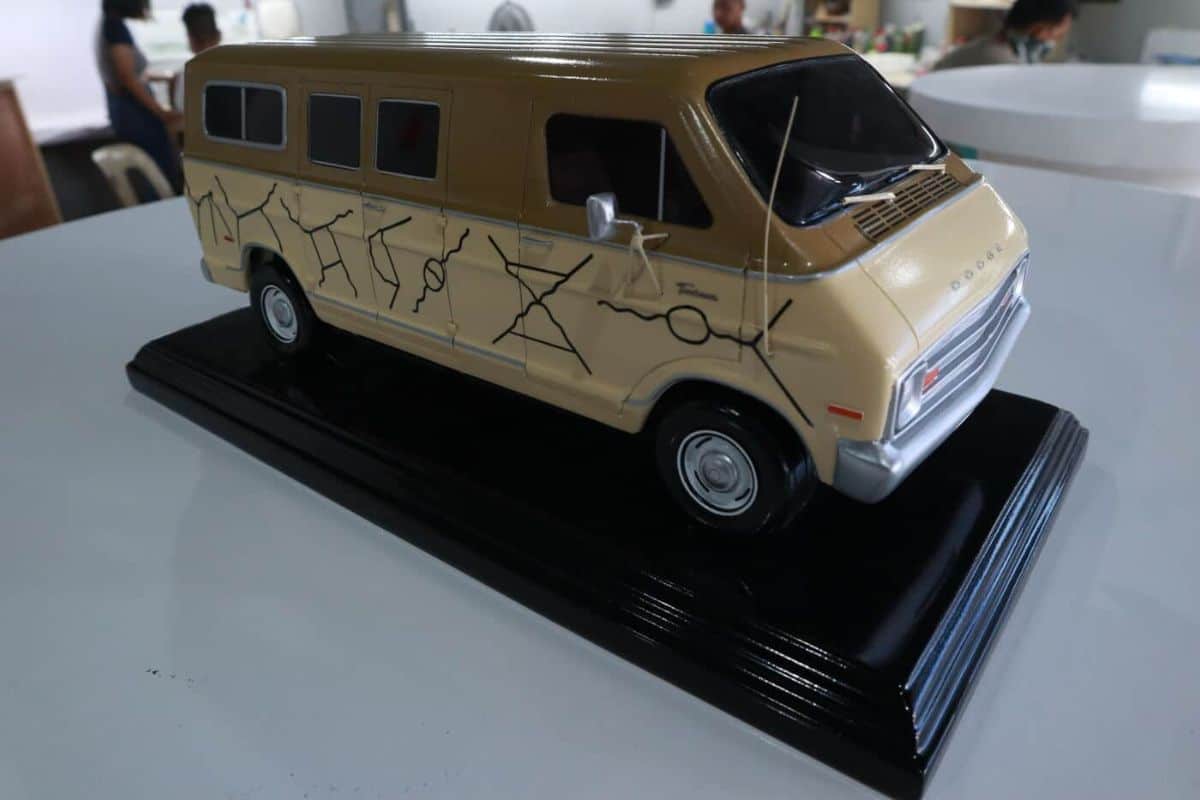
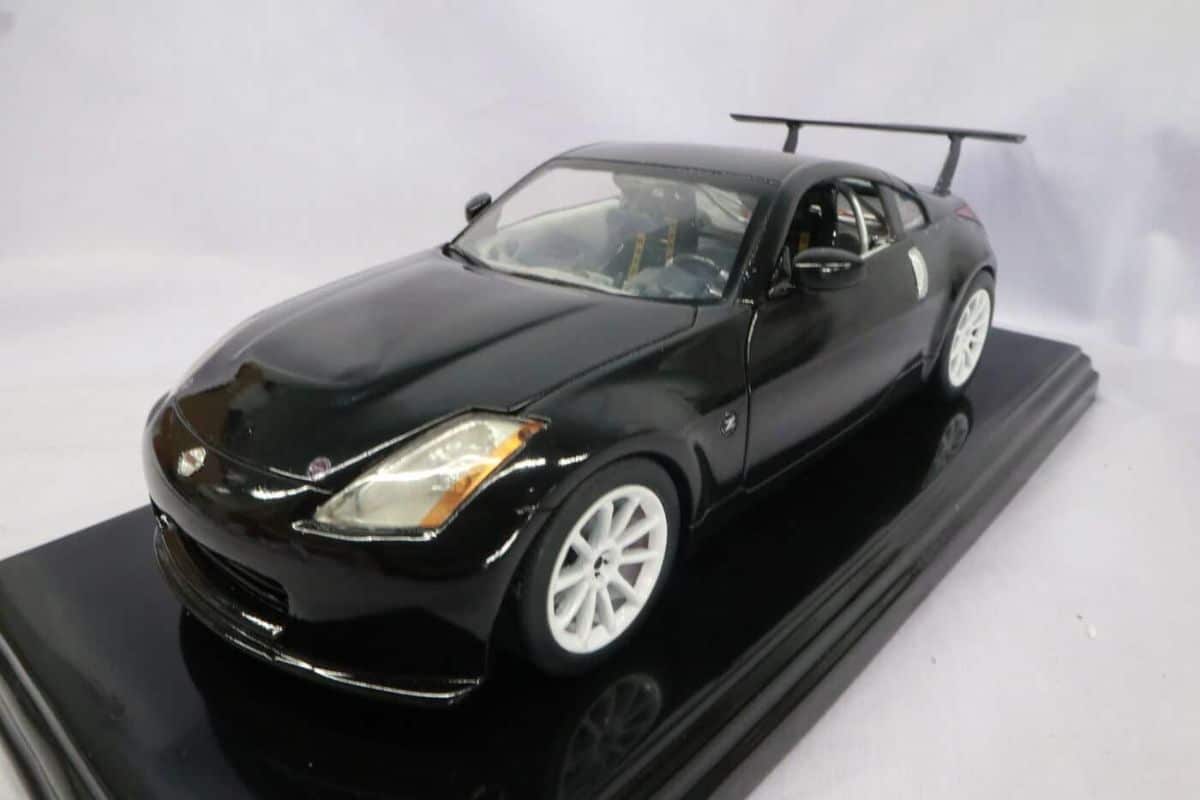
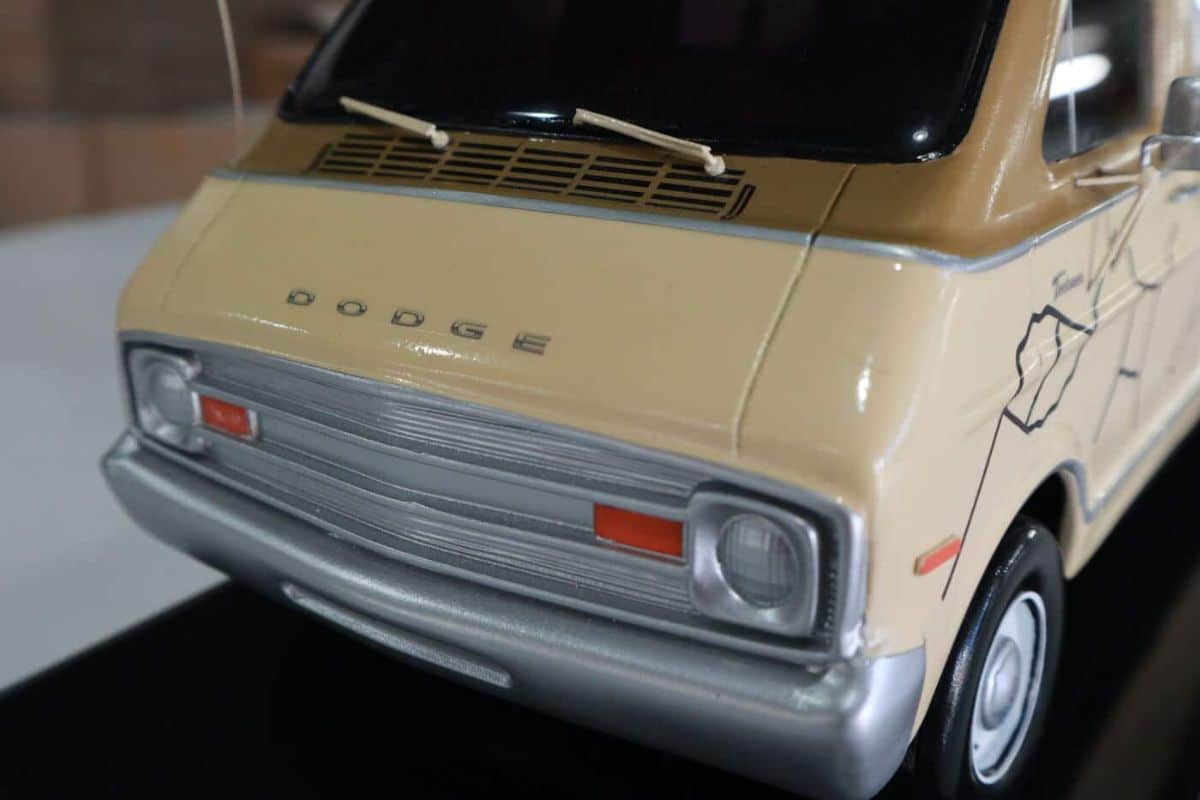
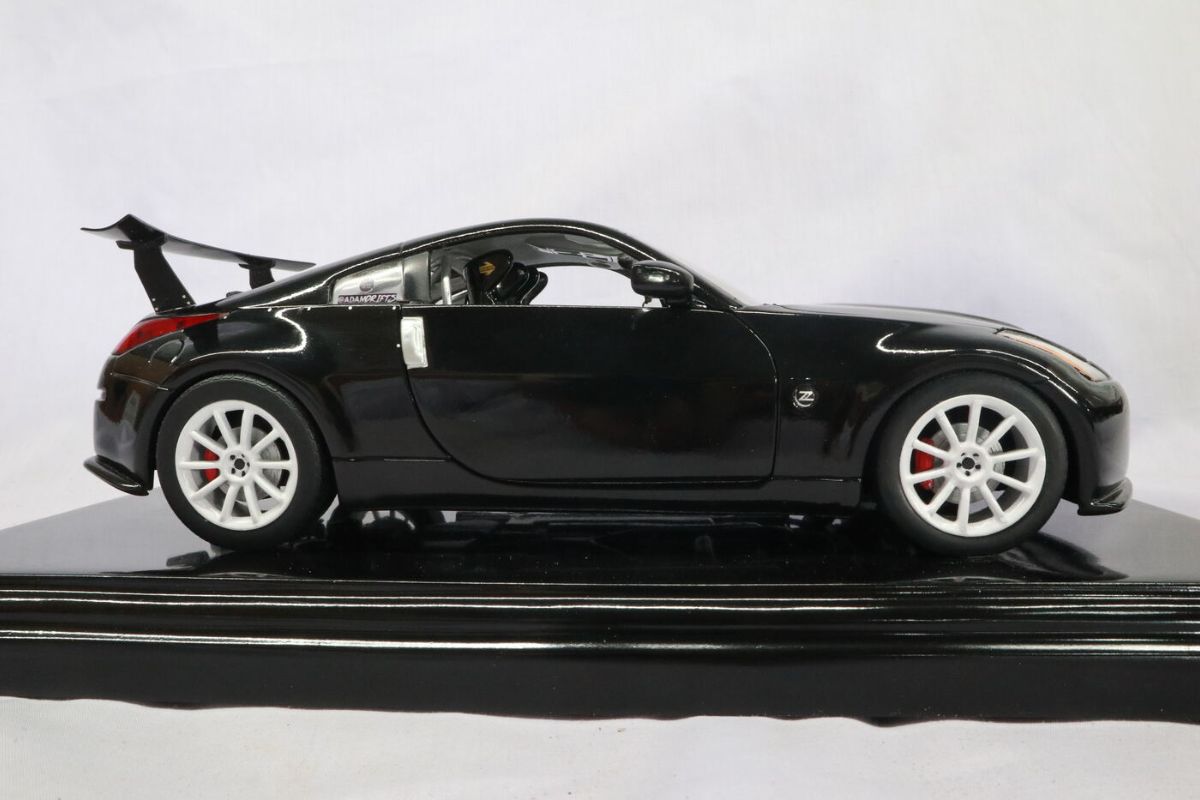
Hand-building reverses the logic. Our models are carved and assembled by hand from solid mahogany, painted by hand and mounted on a solid wooden display base, so an unusual subject costs no more to tool than a popular one. We work from the photographs you send, so your own car, in its real colour and with its real modifications, becomes the model. The Dodge van and Nissan 350Z in this article are examples: neither is a catalogue car, and both were built from customer references. You can pick any scale; see our custom car models page for how an order works.
How to Choose Your Scale
- 1:12 to 1:10 (about 37 to 45 cm): the entry to oversized. Fits a shelf or desk and suits gifts.
- 1:8 (about 56 cm): the collector’s sweet spot for cars, with room for interior and engine-bay detail.
- 1:6 to 1:4 (75 to 112 cm): statement pieces for offices, showrooms and large rooms. Measure the table or plinth first; a 1:4 car is longer than most coffee tables.
- Ships and aircraft: the same ratios give very different lengths, so check the real dimensions first. Our big model airplanes, giant-scale models and large-scale exhibition models pages show finished examples.
Still unsure? Our guide to custom size scale models walks through matching size to space and budget.
How to Display and Protect a Large Model
Light is the biggest long-term risk. Conservators measure it in lux-hours (light level times hours exposed), and the standard recommendation for sensitive objects is 50 to 100 lux, according to the CCAHA guide to light exposure. The American Museum of Natural History gives a handy example: 50 lux for 24 hours a day equals 200 lux for 6 hours, both 1,200 lux-hours. In practice that means three rules:
- Keep the model out of direct sun. Sunlight is hundreds of times brighter than a lit room, so a window ledge uses up years of safe exposure quickly.
- Choose a cover or cabinet with a stated UV-filter percentage (98% or better); if none is listed, do not assume any.
- Use LED lighting with low UV output, placed outside the case so heat does not build inside.
For wooden models also avoid radiators and air-conditioning vents, which swing humidity and temperature, and dust with a soft brush rather than a damp cloth. Allow for weight and footprint: oversized models need a stable surface, and anything at 1:6 or larger should sit on furniture rated for it.
Buying Checklist
- Ask for the scale and the finished length in centimetres, not just “large”.
- Ask how the model is made (cast, kit, or hand-built) and, where published, the parts count.
- Check what is included: base, cover, certificate, shipping crate.
- For a one-off, confirm who supplies reference photographs and who approves the finish.
- Measure your display space with the packaged size in mind.
Frequently Asked Questions
What is the largest standard diecast scale?
1:12 is usually described as the largest common diecast scale, about 14 inches for a typical car. Larger models are generally kits, limited editions or handcrafted work.
How much does a 1:8 model car cost?
Premium hand-built 1:8 models from the leading makers run from about £8,000 to over £20,000 per Motor Sport. Pocher-style kits cost far less but need many hours of assembly.
Is a 1:8 model heavier than a 1:18?
Much. Linear size is 2.25 times larger, and volume about 11 times, so a solid model needs far more material. Pocher’s largest kits reached 7.3 kg.
Can I order an oversized model of my own car?
Yes. Send photographs and the scale or size you want. Browse our automotive gallery for finished builds.
Are your models diecast?
No. They are handcrafted from solid mahogany, which lets us build any car at any scale from photographs without a mould.
Ready to go beyond the standard shelf? Browse the full gallery of finished models, or start your oversized model from photos.