
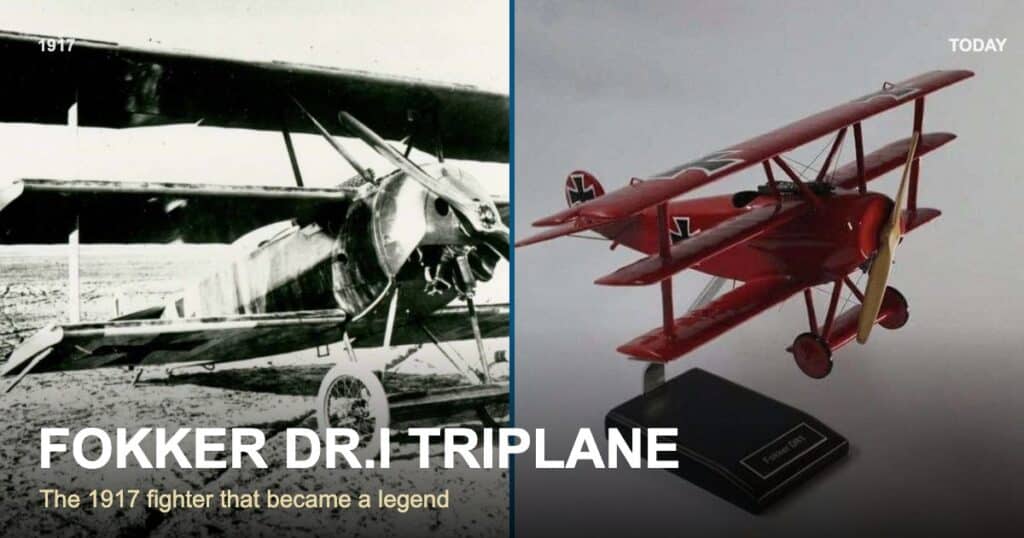
The Fokker Dr.I was never a fighter that dominated the skies. Only about 320 were built, it was slower than several Allied rivals, and it spent much of its short career fighting for the right to be called safe. Yet it is probably the most recognised German aircraft of the First World War. The reason is a single colour, a single pilot and a few months in 1917 and 1918 that fixed the shape of the triplane in popular memory.
This guide covers where the Dr.I came from, how it performed, what went wrong with its wings, who flew it, and what became of it. It also explains how a handcrafted triplane model captures the details of a machine like this.
Quick facts: the Fokker Dr.I at a glance
- Name: Dr.I stands for Dreidecker, German for “three-decker”, with the I marking the first type in the class.
- Designer: Reinhold Platz, working for Anthony Fokker.
- First flight: 5 July 1917 (the V.4 prototype).
- Built: about 320, with production ending in May 1918.
- Engine: one 110 hp Oberursel Ur.II rotary.
- Armament: two synchronised 7.92 mm machine guns.
- Best known for: Manfred von Richthofen’s final victories and his death in Dr.I 425/17 on 21 April 1918.
Where did the Fokker Dr.I come from?
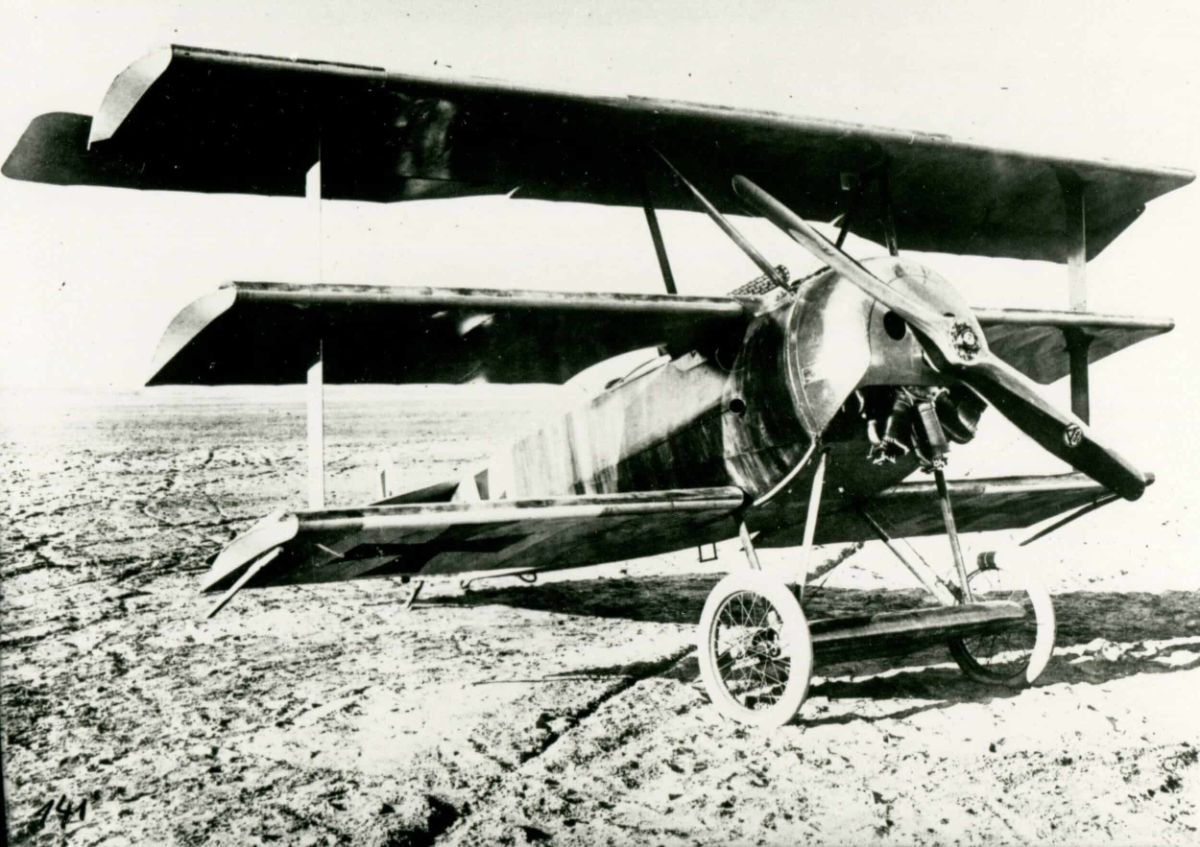
The Dr.I was a reaction to a British aeroplane. In April 1917 Anthony Fokker saw a captured Sopwith Triplane, a nimble fighter that climbed quickly and turned tightly. German pilots who met it came away impressed. Fokker is said to have told his designer Reinhold Platz to build a triplane of his own, with no further design detail.
Platz’s answer was the V.4 prototype, which first flew on 5 July 1917. It was followed by the V.5 and then two pre-production F.I aircraft, serials 102/17 and 103/17. The two F.I machines reached the front in late August 1917 for combat evaluation, and the type was ordered into production as the Dr.I.
The appeal of three wings is that they give plenty of lifting area on a short span, which helps manoeuvrability and rate of climb. Fokker’s version also followed the company’s usual practice: a fuselage of welded steel tube covered in fabric, and thick cantilever wings with no external bracing wires.
If you want the bigger picture first, our guide to what a triplane is and why First World War pilots flew them explains the layout in detail.
Fokker Dr.I specifications
The figures below are for the production Dr.I with the 110 hp Oberursel Ur.II rotary. Sources differ slightly on some performance numbers, so treat speed in particular as approximate.
| Crew | 1 |
| Engine | Oberursel Ur.II, nine-cylinder rotary, 110 hp (82 kW) |
| Upper wingspan | 7.19 m (23 ft 7 in) |
| Middle / lower wingspan | 6.23 m / 5.73 m |
| Length | 5.77 m (18 ft 11 in) |
| Height | 2.95 m (9 ft 8 in) |
| Wing area | 18.7 m² (201 sq ft) |
| Empty weight | 406 kg (895 lb) |
| Loaded weight | 586 kg (1,291 lb) |
| Maximum speed | roughly 165 to 185 km/h (about 103 to 115 mph), depending on source and altitude |
| Climb | 1,000 m in about 2 minutes 54 seconds |
| Service ceiling | about 6,100 m (20,000 ft) |
| Endurance | about 1 hour 30 minutes |
| Armament | 2 × 7.92 mm synchronised machine guns |
The numbers explain the aeroplane’s character. A light airframe with three wings and a modest engine meant a fast climb and an extremely tight turn, but also high drag and a top speed below that of the best Allied fighters of 1918.
Werner Voss and the first Dr.I in combat
The first pilot to make the triplane famous was not Richthofen. Werner Voss, a 20-year-old ace with 48 confirmed victories, flew pre-production F.I 103/17 in September 1917 and scored his last ten victories in it.
On 23 September 1917, near Poelkapelle in Belgium, Voss fought alone against a group of British pilots from No. 56 and No. 60 Squadrons, among them James McCudden and Arthur Rhys Davids. An observer timed the fight at around eight minutes, although the pilots involved remembered it as far longer. Voss hit several of his opponents’ machines before he was killed. McCudden later described the fight with open admiration. It is still regarded as one of the great single combats of the war and it made the new triplane famous before production Dr.Is had reached the front.
The wing failures of 1917
Production Dr.Is began reaching Jagdgeschwader I in October 1917, and the type almost immediately ran into trouble. In the last days of that month a series of accidents involved upper-wing failures:
- Heinrich Gontermann, a 39-victory ace, was killed in late October when his Dr.I broke up in the air.
- On 30 October Manfred von Richthofen crashed Dr.I 114/17 after it came apart; he was unhurt.
- On 31 October Günther Pastor of Jasta 11 was killed when the upper wing of Dr.I 121/17 collapsed.
The type was grounded on 2 November 1917 while a crash committee investigated, and the authorities cleared it to fly again on 28 November. The investigation pointed to poor construction of the upper wing and inadequate protection against moisture, which weakened the glue and the structure. Fokker was ordered to replace the wings at his own expense and to build them to a higher standard.
The fix helped, but did not end the problem. Later analysis by aviation historians suggests that the failures were “stripping” of the upper wing’s ribs and leading edge rather than spar breakage, and that the forward upper surface carried unusually high loads at high angles of attack. Reissued wings still failed occasionally, but in a way that pilots could survive. Pilots learned to treat the aircraft with care.
What was the Fokker Dr.I like to fly?
When it worked, the triplane was formidable in a close fight. Three wings of different spans gave plenty of lift at low speed, which meant a tight turn radius and a climb rate that surprised pilots on faster aircraft. Experienced pilots used it for exactly this: get close, turn tighter than the opponent, and fire.
The same design made it a poor choice for a pilot who wanted to dive away or fight at altitude. High drag held its speed down, and by the spring of 1918 Allied fighters such as the S.E.5a and Sopwith Camel had better all-round performance. By then the Dr.I was a specialist tool for skilled pilots rather than a general-purpose fighter.
Manfred von Richthofen and the Red Baron legend
Richthofen flew the Dr.I from late 1917 into 1918 and scored roughly the last 20 of his 80 victories in the triplane, with most sources putting around 19 of his final 21 in a Dr.I (accounts vary slightly on the exact split). The red paint became his trademark and, for his Jagdgeschwader 1, a sort of group identity. Other pilots in the wing used their own bright colours, which is how it earned the nickname “Flying Circus”.
He was killed on 21 April 1918 flying Dr.I 425/17, shot down near the Somme valley. Who fired the fatal shot is still argued. Many historians now believe that ground fire from Australian machine gunners was the most likely cause, but the evidence is disputed and the question has never been settled.
How many Fokker Dr.Is were built, and what happened to them?
About 320 production aircraft were built, and production ended in May 1918. Front-line numbers peaked at 171 aircraft in late April 1918. Within weeks the Fokker D.VII began arriving and the Dr.I was withdrawn from front-line service through June and July 1918, with Jasta 19 the last unit fully equipped with it.
No complete original survives today. Richthofen’s own triplane was displayed in Berlin and destroyed in Allied bombing in the Second World War, and an aircraft Fokker assembled from existing parts in 1932 was lost to bombing in 1943. Almost every Dr.I you can see in a museum or at an air show is a replica. The Museum of Flight in Seattle displays one, begun in 1958 and completed in 1972, then rebuilt after an accident and fitted with a period Le Rhône rotary in 1990.
Why the Fokker Dr.I makes such a good scale model
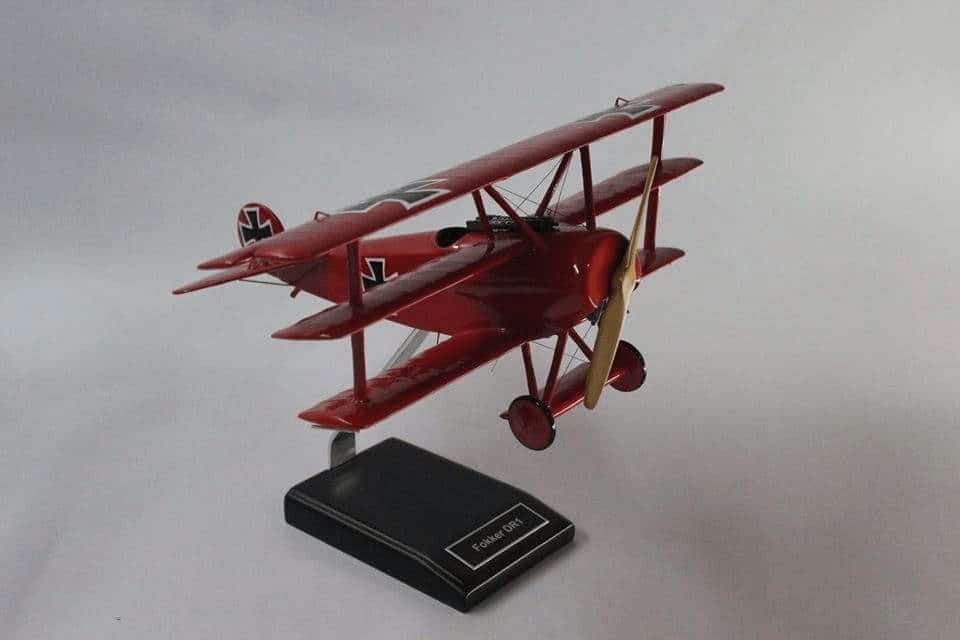
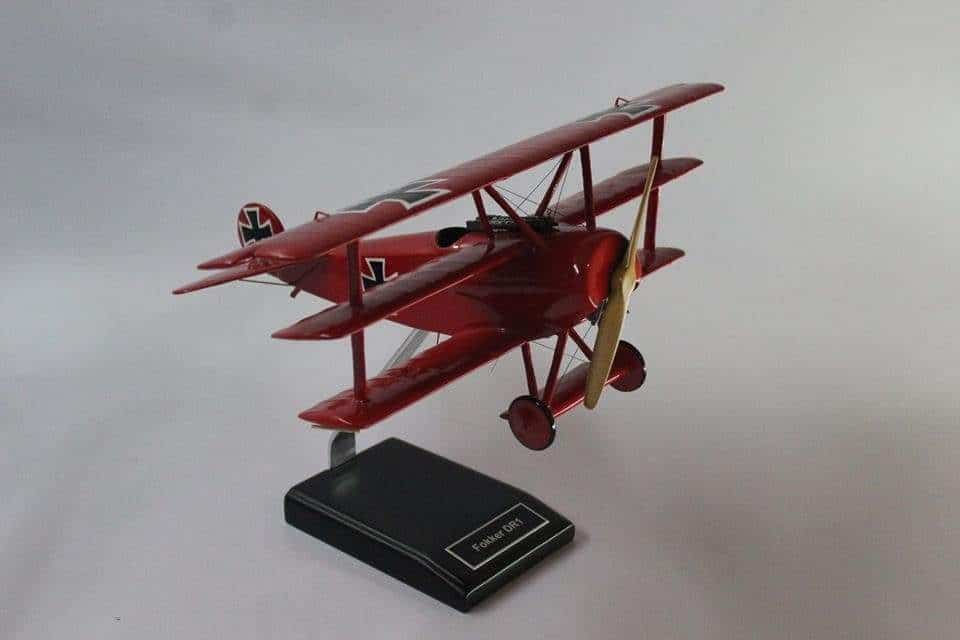
Few aircraft look as good on a shelf. The three stacked wings, the round engine cowling, the iron cross markings and the high-contrast paint give a model a lot to show off, and the Dr.I’s compact size means even a large scale fits on a desk.
That is also why accuracy matters. A convincing model needs the right wing proportions (the upper wing longer than the other two), the right cowling and the right colours for the specific aircraft. A red triplane is not just a red triplane: Richthofen’s all-red machine, the other Jasta 11 pilots’ aircraft with their own markings and the F.I that Voss flew each look different.
Build a Dr.I from your photos
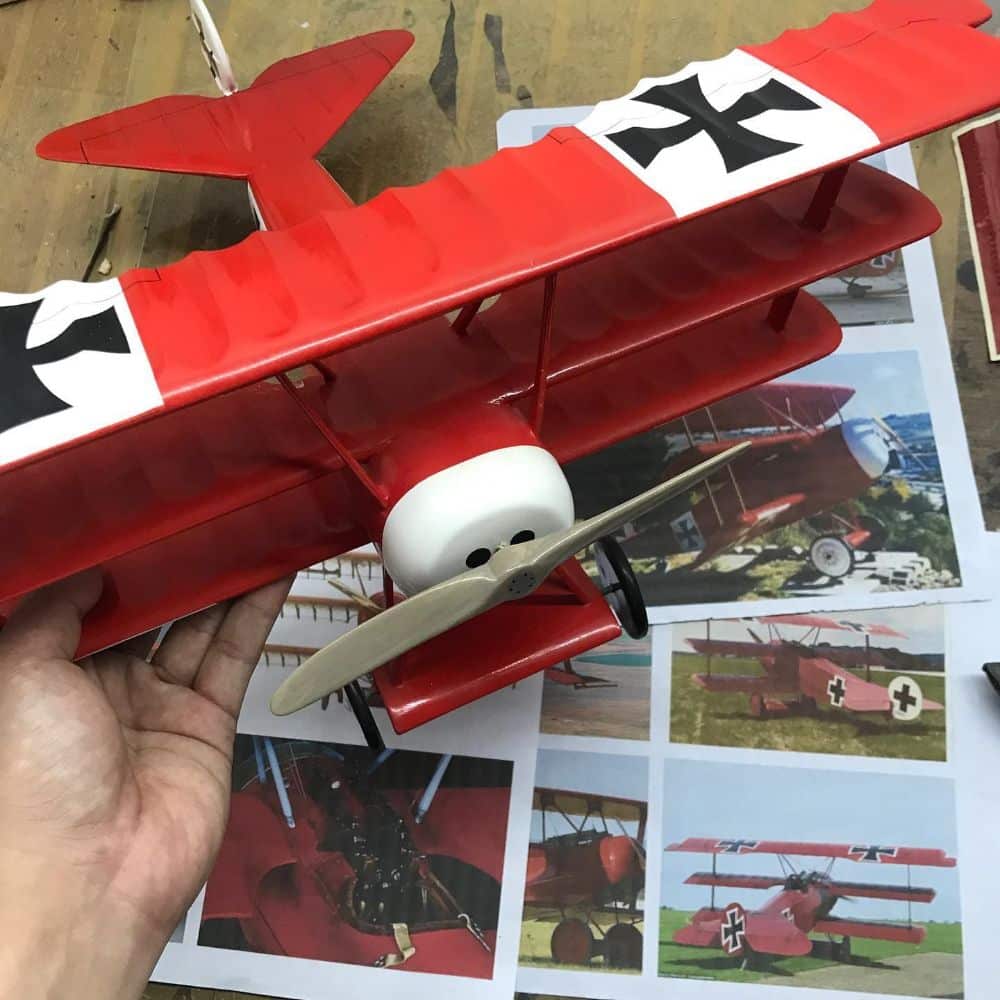
Modelworks Direct builds custom aircraft models by hand, working from photos you send. Each model is handcrafted from solid mahogany wood, hand-painted, and mounted on a solid wooden display base, in any scale you choose. If you have a specific aircraft in mind, such as Richthofen’s red triplane, Voss’s F.I or a Dr.I flown by a relative’s squadron, send the references and we build to match the livery and details. You can see the range in our aircraft model gallery, or start with our custom airplane models.
Not sure what scale suits your shelf or desk? Our model scale calculator shows the size of a model at each scale, and larger display pieces are covered on our big model airplanes page.
When you are ready, request a free, no-obligation quote. Name plate engraving and gift boxing are available if the model is a gift.
Frequently asked questions
What does Dr.I mean?
Dr stands for Dreidecker, German for “three-decker” (triplane). The I marks it as the first type in the German triplane designation.
How many Fokker Dr.Is were built?
About 320 production aircraft, plus two pre-production F.I prototypes, before production ended in May 1918.
Was the Red Baron shot down in a Fokker Dr.I?
Yes. Manfred von Richthofen was killed on 21 April 1918 flying Dr.I 425/17. The exact origin of the fatal bullet is still debated, although many historians favour ground fire.
Why did the Dr.I have wing problems?
The 1917 failures were traced to poor upper-wing construction and moisture damage, and the type was grounded on 2 November 1917 before being cleared to fly again on 28 November.
How fast was the Fokker Dr.I?
Roughly 165 to 185 km/h (about 103 to 115 mph), depending on the source and altitude. It was slower than the best Allied fighters but climbed and turned very well.
Does an original Fokker Dr.I still exist?
No complete original is known to survive. Aircraft seen in museums and at air shows are replicas, many using radial engines in place of the original rotary.
Can I order a handcrafted model of a Fokker Dr.I?
Yes. A model can be built from your photos in any scale, handcrafted from solid mahogany wood and hand-painted. See our custom aircraft models or how to order.