

The first time you watch a Jetson ONE lift cleanly off the ground, your brain hesitates for a second. It doesn’t look like an aircraft in the traditional sense. No fuselage. No wings. Just a skeletal frame, eight rotors, and a pilot sitting out in the open air like something pulled straight out of a science fiction storyboard.
Then it climbs. Smoothly. Confidently. And you realize this isn’t a concept render. It’s flying.
The Jetson ONE isn’t trying to be a helicopter replacement or a flying taxi for commuters. That’s the mistake many people make when they first hear about it. What it’s really doing is opening the door to something aviation hasn’t had in a long time: an entirely new category of recreational flight.
Almost like the early days of motor racing, when no one quite knew what the sport would become.
What the Jetson ONE actually is
Strip away the hype and you’re left with a very clever piece of engineering. The Jetson ONE is an electric VTOL personal aircraft, built around redundancy rather than brute power. Eight motors. Multiple battery systems. A flight computer constantly stabilizing the platform. A ballistic parachute as a last line of defense.
It’s light. It’s compact. It’s intentionally limited.
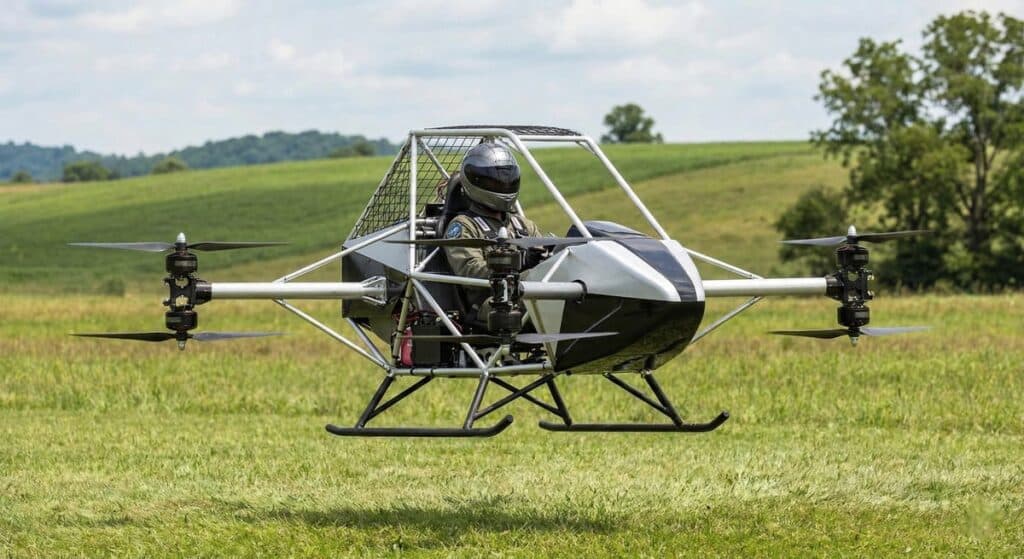
Top speed is modest compared to helicopters. Range is short. Endurance is measured in minutes, not hours. And that’s not a flaw. That’s the point. This isn’t about cross-country capability. It’s about accessibility and immediacy.
You don’t need a runway. You don’t need a hangar. You don’t need years of flight training. You need open space, basic instruction, and respect for the machine.
That combination is what makes it disruptive.
Why it feels like the beginning of something, not a finished product
Every transformative aviation era starts with awkward machines.
The Wright Flyer looked fragile. Early helicopters looked dangerous. The first ultralights looked like lawn chairs with wings. Yet each of those categories eventually found its identity.
The Jetson ONE sits in that same early phase. It’s not trying to solve urban congestion. It’s not pretending to be a certified transport platform. It’s doing something more honest. It’s proving that personal vertical flight can be:
- Technically feasible
- Repeatable
- Learnable
- Enjoyable
That last part matters more than most people realize. Aviation grows when people fall in love with it. Not when they analyze it on paper.
The idea of “Air Games” isn’t as far-fetched as it sounds
Watch how people actually fly the Jetson ONE. They don’t cruise in straight lines. They carve. They climb. They descend. They play with the environment. It’s closer to freestyle motocross than conventional aviation.
That’s where the idea of aerial competition starts to feel inevitable.

Not airline-style regulation-heavy flying. But structured events. Courses. Timed runs. Precision challenges. Obstacle navigation. Energy management. Pilot skill on display, not hidden behind automation.
It wouldn’t look like Red Bull Air Race. It would be smaller, tighter, more intimate. More accessible. And honestly, more relatable to a generation raised on drones, FPV flying, and esports.
The technology invites this direction.
A new kind of aircraft creates a new kind of enthusiast
Traditional aviation enthusiasts are drawn to history, machinery, systems. Jetson ONE attracts a different crowd. Creators. Builders. Gamers. Engineers who grew up with electric skateboards and 3D printers instead of carburetors and magnetos.
That’s not a threat to aviation culture. It’s an expansion of it.
You’re already seeing it in how people engage with these machines. Custom liveries. Personal modifications. Filmed flights edited like action sports content. This is aviation filtered through a different generation’s lens.
And that’s healthy.
Where collectors fit into this story
Whenever a new category of aircraft emerges, the earliest machines become the most culturally valuable. Not because they’re perfect, but because they represent the moment something changed.
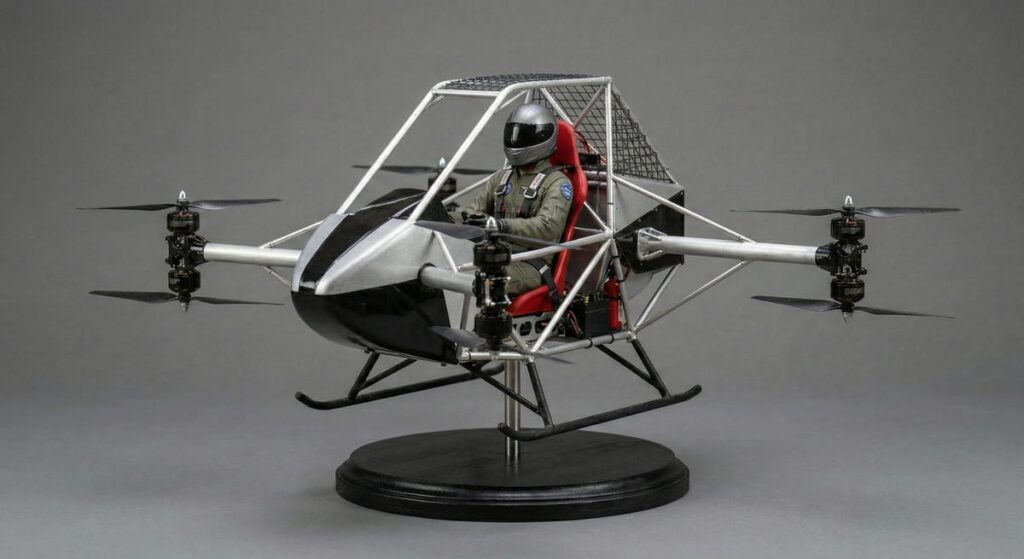
For collectors and aviation historians, the Jetson ONE is already edging toward that space. A well-crafted model of a Jetson ONE tells a very specific story: the moment personal electric flight stepped out of theory and into reality.
You can imagine future collections where a Wright Flyer sits on one shelf, an early ultralight on another, and a Jetson ONE alongside them. Different eras. Same spirit.
Early adopters always become history, whether they intend to or not.
This isn’t about replacing aircraft. It’s about redefining who gets to fly.
The Jetson ONE won’t make helicopters obsolete. It won’t replace training aircraft. It won’t compete with serious aviation platforms. That’s not its lane.
Its real impact is cultural.
It lowers the psychological barrier to flight. It makes vertical lift feel less like an elite profession and more like a human experience again. The same way skateboards made motion personal, or drones made aerial perspectives normal.
If organized “air games” emerge around platforms like this, they won’t be a gimmick. They’ll be a sign that aviation has found a new grassroots layer.
And aviation has always grown strongest from the grassroots up.
Not from boardrooms. Not from regulations. From people who simply looked at the sky and thought, I want to be up there too.