

Scale model collecting is one of the broadest and deepest hobby traditions in the world — a market that spans every category of machine human beings have built, every era of engineering history, and every level of collecting commitment from the casual display piece to the obsessively researched commission. Whether the subject is model planes from the WW2 era, precision automotive replicas, or tall ship models from the age of sail, the collecting framework is identical: specific subject, appropriate scale, quality that honours what is being represented.

This guide covers the most significant collecting subjects across the three primary scale model categories: automotive, aviation, and maritime. Whether you are just starting out with model car building or deepening a collection that spans decades, the subjects here are the ones that reward the most serious attention — the pieces that hold their significance over time and tell stories that no other format communicates as directly.
The Automotive Collector’s Subjects — From Factory Icons to Personal Commissions
Top automotive collecting subjects: Ferrari 250 GTO · Shelby Cobra · Ford GT40 · Porsche 917 · McLaren F1 · Lamborghini Miura · Personal commissions — specific vehicles with biographical significance
The automotive collecting category is the broadest in scale model culture — spanning racing cars, road cars, commercial vehicles, trucks, and historic machines across every era from the Benz Patent-Motorwagen of 1885 to the most recently released performance cars. The subjects that consistently produce the strongest collecting engagement share the quality described throughout this guide: they reference something specific rather than something general, they were designed for a purpose that required uncompromising engineering, and they carry a visual identity so clear that they are immediately recognisable in miniature as in full size.

Car model making at the serious collector level is not simply the acquisition of available die-cast pieces. It is the considered assembly of a display that tells a coherent story — across manufacturers, eras, or personal biography — through subjects chosen for reasons that will still be true in twenty years. The Ferrari 250 GTO collector who has spent time understanding why those 36 examples represent the pinnacle of road-registered racing car design has built a relationship with the subject that the piece on their shelf reflects. The collector who has simply acquired the most famous and most expensive subject available has built a display that impresses visitors but may not sustain the collector’s own interest as thoroughly.
Model car building from kits adds a further dimension that ready-made acquisition does not provide: the knowledge that comes from assembling the vehicle at scale. The 1:24 Porsche 917 kit builder who has spent forty hours fitting body panels, painting the Gulf livery, and detailing the flat-12 engine visible through the rear bodywork has an understanding of that vehicle’s architecture — the wide bodywork, the low centre of gravity, the specific proportions that made it the fastest sports racing car of its era — that the photograph on the box cannot produce and the finished die-cast cannot either. The building process is, for many collectors, as valuable as the finished piece.
The most personally significant automotive collecting decisions involve the commission rather than the catalogue. The collector who wants to build your own car replica — the specific vehicle whose registration, colour, and configuration reference a specific chapter of their own history — cannot find that subject in any production catalogue. The commission that produces a 1:18 replica of the specific Toyota Camry that covered 180,000 miles, or the specific racing car whose livery and number were present at the most significant event the collector attended, or the first car they bought with their own money in a colour no manufacturer catalogued for that model year — that commission produces an object that exists for one collection and could not have been found anywhere else. That specificity is the highest form of automotive collecting value available.
The Aviation Collector’s Subjects — From WW2 Classics to the Rarest Pre-War Racers
Top aviation collecting subjects: Spitfire · P-51 Mustang · Gee Bee Model R · B-17 Flying Fortress · F-14 Tomcat · F-22 Raptor · Concorde · Boeing 747 · Lockheed SR-71
Aviation collecting is the category with the longest continuous tradition in scale model culture — aircraft replicas predate the aviation industry itself, as the Wright Brothers and their predecessors used scale models to test wing section geometry before committing to full-size construction. The aviation collector today inherits a tradition that spans the entire history of flight, from the wire-and-fabric biplanes of the First World War through the jet age to the blended-surface stealth aircraft of the present generation. Every era produced machines whose design was driven by the requirement to outperform a competitor or solve an engineering problem that had not previously been solved — and every era’s most significant machines carry that design intensity in their form.

The ww2 model plane category remains the single most active segment of aviation collecting globally — the six years of the Second World War produced a concentration of significant aircraft design that no comparable period has matched. The Spitfire, the P-51 Mustang, the Focke-Wulf Fw 190, the Mitsubishi Zero, the B-17 Flying Fortress, the de Havilland Mosquito — each is a complete argument about what a specific nation’s aviation industry was capable of under maximum competitive pressure. A display that spans all six major combatant nations’ primary fighter types tells the complete story of WW2 aerial combat in six objects, each immediately recognisable, each carrying a specific national engineering identity that the collector who understands the context can read directly from the surface.
Beyond the WW2 category, the pre-war air racing subjects offer some of the most visually extraordinary collecting pieces available anywhere in aviation. The Gee Bee Model R — the barrel-bodied, radial-engined air racer designed by the Granville Brothers and flown to the 1932 Thompson Trophy by Jimmy Doolittle — is among the most distinctive aircraft silhouettes in history. Its near-spherical fuselage, minimal forward cockpit visibility, and enormous radial engine cowling produce a shape that looks improbable from every angle and yet was the most aerodynamically refined racing aircraft of its era. A Gee Bee model plane at 1:32 or larger is the kind of display piece that stops conversation in any room it occupies — immediately recognisable to anyone with aviation knowledge, completely baffling to everyone else, and supremely rewarding to explain.

The fighter plane model category extends from the First World War’s wire-braced biplanes to the current generation of supercruise stealth fighters — a collecting range of over a century of military aviation development. For collectors whose primary interest is jet age military subjects, the Cold War pairing approach produces the most coherent displays: F-86 Sabre alongside MiG-15, F-14 Tomcat alongside Su-27 Flanker, F-22 Raptor representing the Western technology ceiling against which all current-generation fighter development is measured. Each pairing documents a specific chapter of the technological competition that drove the most intensive period of aviation engineering development outside wartime.

For collectors who want the maximum physical impact from their aviation display, large scale aircraft — subjects at 1:32 and above, or commercial airliners at 1:100 and larger — produce display pieces whose physical presence communicates the aircraft’s scale relationship to its environment in a way that smaller replicas cannot approach. A Boeing 747 at 1:100 is over 700mm in length. A Spitfire at 1:24 has a wingspan approaching 500mm. These are objects that require dedicated display space and reward it with a visual authority that smaller wooden aircraft models and production die-cast pieces cannot match. The collector who has the space for a large scale subject and chooses to fill it with the most significant aircraft in their collection makes a display decision that every visitor will immediately understand — and that the collector will not regret as the years accumulate around it.
The collecting framework is the same across every category and every scale: specific subject, quality that honours what is being represented, and a reason for the choice that will still be true in twenty years. Everything else follows from those three decisions.
The Maritime Collector’s Subjects — From Age-of-Sail Masterpieces to the World’s Most Famous Ships
Top maritime collecting subjects: USS Constitution · RMS Titanic · HMS Victory · Cutty Sark · Bismarck · HMS Bounty · Sovereign of the Seas · Queen Mary · Mayflower
Maritime scale model collecting is the oldest of the three primary categories — ship models predate aviation and automotive collecting by millennia. The Admiralty model tradition of the seventeenth and eighteenth centuries produced some of the finest craft objects ever made, built to exacting standards from boxwood, ivory, and brass by skilled craftspeople whose work documented naval architecture with a precision that no other available medium could approach. A boat model produced in that tradition — individually planked, fully rigged, period-accurate in every detail — is a craft object of extraordinary quality that contemporary maritime collecting inherits directly. The standard of accuracy and the attention to period-correct detail that the best contemporary maritime models achieve connects to four hundred years of accumulated craft knowledge.
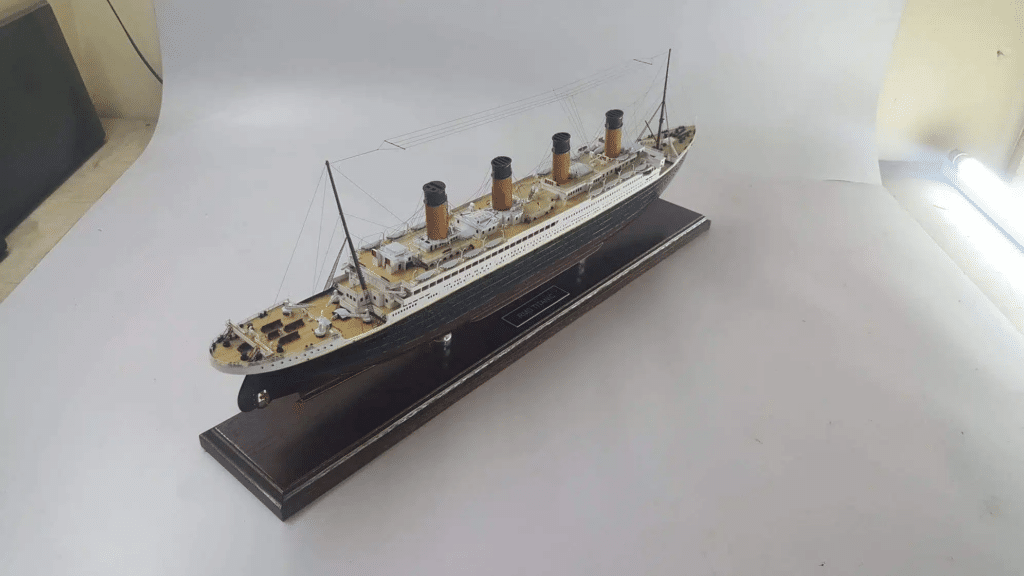
The Titanic ship model occupies a position in maritime collecting that no other vessel quite matches. The RMS Titanic is simultaneously the most written-about ship in history, the most cinematically documented, and the most emotionally resonant maritime subject available to any collector. Its story — the largest moving object built by human hands at the time of its launch, the most technologically advanced passenger vessel in the world, sunk on its maiden voyage with the loss of over 1,500 lives — carries a narrative weight that makes a precision replica more than a decorative object. It is a document of hubris, tragedy, and the specific moment in maritime history when the belief that engineering could overcome any natural obstacle encountered its most definitive correction. A Titanic model at 1:700 or larger, correctly detailed with period-accurate funnels, deck furniture, and davit configuration, is the most historically charged single object available in the maritime collecting category.

The USS Constitution ship model represents a completely different but equally compelling collecting argument. Old Ironsides — as the Constitution has been known since the War of 1812, when British cannon shot was reported to have bounced off her oak hull — is the oldest commissioned naval vessel in the world still afloat, and the most significant surviving artefact of the early American Republic’s naval history. The Constitution’s record of forty-two victories and zero defeats in her active service period, her role in establishing American naval credibility in the early nineteenth century, and her survival across two centuries of preservation efforts give her a historical weight that the collector who understands American naval history will find entirely compelling. A precision Constitution model in full sail configuration — accurate to her 1797 rig, with the period-correct black and white paintwork of her active service years — is one of the most historically specific display pieces available in the entire scale model market.
For the maritime collector whose primary interest is the age of sail rather than specific named vessels, the tall ship subjects — full-rigged ships, barques, brigs, and frigates from the seventeenth through nineteenth centuries — offer the greatest depth of historical material and the most demanding accuracy standards. A boat model of a specific vessel in the age-of-sail tradition — individually planked hull, fully rigged masts, period-accurate cannon placement and deck furniture — is a craft object of a complexity and a quality that contemporary automotive and aviation collecting approaches but does not exceed. The rigging alone of a correctly made full-rigged ship model involves hundreds of individual lines, each correctly positioned, correctly tensioned, and correctly identified in the period’s naval nomenclature. The collector who commissions or acquires such a piece owns something that represents the pinnacle of scale model craft — and that will be as compelling to examine in fifty years as it is today.
Building Across All Three — How to Make Air, Sea, and Road Work Together
The collector who wants to span all three categories faces one primary curatorial decision: the connecting principle that makes the display coherent rather than simply broad. Three principles work consistently well. Period coherence places subjects from the same historical era across all three categories — a WW2 fighter, a WW2 era destroyer, and a 1940s Grand Prix car displayed together tell the complete story of what human engineering produced during a single decade across three different operating environments. The connection is immediately legible to any visitor who understands the context.
National identity places the automotive, aviation, and maritime output of a specific country in a specific period — British aviation (Spitfire), British maritime (HMS Victory), and British automotive (Aston Martin DBR1) displayed together tell the story of British engineering excellence across its three defining competitive arenas. The display argument is specific enough to be interesting and broad enough to demonstrate genuine knowledge of each category.
Engineering philosophy places subjects across categories that represent the same approach to the same underlying problem — maximum performance from minimum weight, or maximum endurance from minimum fuel, or the most resolved possible expression of a specific design brief — regardless of era or nationality. This is the most sophisticated connecting principle and the one that produces the most interesting conversations, because it requires the collector to have thought carefully about what each subject represents beyond its category and its era. The display that results is the most personal expression of a collecting intelligence available in the scale model world — and the one most likely to reward continued engagement across decades of ownership.
Frequently Asked Questions
What is the most popular scale model subject overall?
The Supermarine Spitfire is consistently the most collected scale model subject globally across all categories — aviation, automotive, and maritime combined. Within the automotive category, the Ferrari 250 GTO dominates. In maritime collecting, the RMS Titanic is the most widely reproduced subject at every scale. The Gee Bee Model R is the most sought-after pre-war aviation subject in the specialist collector market, despite — or perhaps because of — its extreme visual unconventionality.
Is car model making better as a kit build or a commissioned piece?
Both approaches produce valuable collecting objects through different processes. Kit building produces knowledge of the subject alongside the finished piece — the builder develops an understanding of the vehicle’s architecture through the construction process that passive acquisition cannot replicate. Commission produces a piece of higher accuracy for specific subjects — particularly those not available in the standard kit market — and is appropriate when the subject’s personal or historical significance justifies investment in the most accurate possible reproduction. Serious collectors typically use both approaches, reserving commissions for the most personally significant subjects.
What makes the USS Constitution and Titanic particularly significant as maritime collecting subjects?
The USS Constitution is significant as the oldest commissioned warship still afloat and the most historically specific surviving artefact of early American naval history — a vessel whose active service record of forty-two victories, combined with her two-century preservation, makes her the most documentable subject in American maritime collecting. The Titanic carries a different weight: narrative, emotional, and historical simultaneously — the most famous maritime disaster in history, the vessel that represented the peak of Edwardian maritime technology, and the subject that most consistently produces the deepest collector engagement of any ship model subject available.
Why is the Gee Bee Model R such a sought-after aviation collecting subject?
The Gee Bee Model R is sought-after for the combination of extreme visual unconventionality — its near-spherical fuselage is unlike any other aircraft in history — and genuine historical significance as the Thompson Trophy winner of 1932 in the hands of Jimmy Doolittle, who later led the first American bombing raid on Tokyo in WW2. The aircraft’s design represents the pure product of competition engineering with no concession to practicality, aesthetics, or pilot comfort. It is also extraordinarily rare as a physical subject — no complete original survives — making the scale model the primary available form in which the Gee Bee’s extraordinary design can be examined and documented.
The Collection Worth Building — Starting From the Subject That Matters Most
The collecting framework described in this guide — specific subject, quality that honours what is being represented, and a reason for the choice that will still be true in twenty years — applies with equal force to every subject in every category. The WW2 model plane collector and the Titanic ship model collector and the car model building enthusiast are all making the same fundamental decision: which machines, out of the enormous range that human engineering has produced, deserve permanent documentation in the most honest three-dimensional format available.
The answer to that question is always personal before it is historical. The Gee Bee’s extraordinary shape, the Constitution’s unbeaten record, the 250 GTO’s auction dominance — these are reasons that serious collectors give for their subject choices. But the most enduring collections also include the personal subjects: the specific aircraft a pilot trained in, the specific car that covered a continent, the specific vessel that carried a sailor across an ocean. These are the subjects no catalogue supplies and no general collector guide can identify. They are the ones only the collector knows — and the ones whose replicas earn the most permanent place in any collection they join.
Start with the subject that matters most. The collection builds itself around it.