
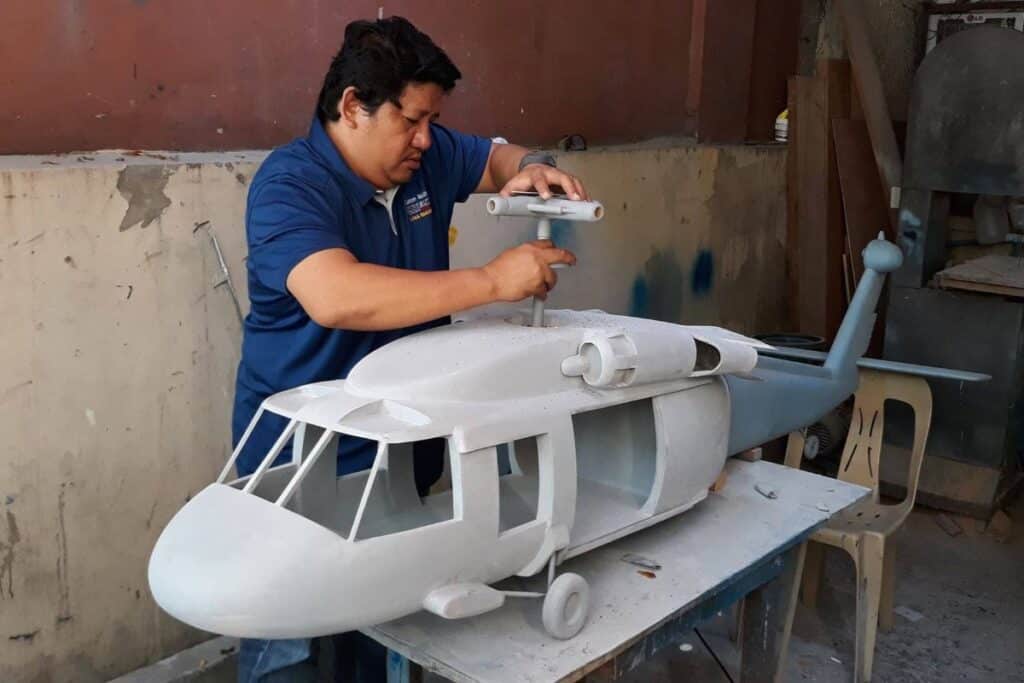
A Boeing 747-400 is 231 ft 10 in long with a 211 ft 5 in wingspan. At 1:500 that jet is 5.6 inches long and sits beside a keyboard. At 1:48 it is almost five feet long and needs its own table. At 1:10 it is more than 23 feet long and needs a hall. Same aircraft, three completely different objects, and the only thing that changed is the number after the colon.
That number is the part most buyers never get to choose. Catalog models come in whatever sizes a factory tooled for. Custom size scale models work the other way round: you decide where the model will live, and the scale follows from that. This guide shows what each size really measures, what changes in the build as the model grows, and how to pick a size before you ask for a quote. Our model scale calculator does the arithmetic for any aircraft, car or ship.
One Aircraft, Seven Sizes: What a Scale Number Actually Means
A scale of 1:100 means every dimension of the model is one hundredth of the real thing. These figures use the published 747-400 dimensions, so you can see how quickly the size changes between common scales. Whether anyone would build a 747 at every one of these sizes is a different question; the table is only about what the numbers mean.
| Scale | Model length | Model wingspan | Where it fits |
|---|---|---|---|
| 1:500 | 5.6 in (14 cm) | 5.1 in (13 cm) | Desk, bookshelf |
| 1:200 | 13.9 in (35 cm) | 12.7 in (32 cm) | Desk, credenza |
| 1:100 | 27.8 in (71 cm) | 25.4 in (64 cm) | Shelf, display case |
| 1:48 | 4 ft 10 in (1.47 m) | 4 ft 5 in (1.34 m) | Table stand, reception |
| 1:20 | 11 ft 7 in (3.53 m) | 10 ft 7 in (3.22 m) | Atrium, gallery |
| 1:10 | 23 ft 2 in (7.07 m) | 21 ft 2 in (6.44 m) | Hall, hangar |
| 1:4 | 58 ft (17.7 m) | 52 ft 10 in (16.1 m) | Museum floor |
At 1:1 the model is the same size as the aircraft. We are building one right now, a full-size P-51 Mustang, and the process is covered in our guide to 1:1 scale aircraft models. If you want every ratio from 1:8 to 1:700 on one page, the model scale chart lists them all.
Desk-Size Models (1:500 to 1:100): Detail You Can Hold
This is the range most people know. A 1:200 airliner is under 14 inches long, so it fits a credenza, ships easily and can be handled without a second thought. Every model we make at this size is a handcrafted piece, and many customers order them as gifts or as pieces for an office.

The trade-off is detail. A 1:500 model gets the livery, the engine count and the overall shape right, but you will not see cabin windows individually or panel lines. Move to 1:100 and the same aircraft is 27.8 inches long, large enough for tail markings, gear doors and engine fan faces to read properly. If your priority is a faithful livery on a model you can hold, start with our custom aircraft models or look at the ready-to-ship models if you cannot wait for a made-to-order build. Our guide to small-scale model aircraft compares 1:72, 1:48, 1:144 and 1:200 in more depth.
Display-Case to Tabletop (1:100 to 1:48): Where Models Start to Look Like Machines
Museums use this range constantly, because it is the point where a model can show real structure without needing a floor of its own. The Budapest Transport Museum, for example, labels its tug model of the PD Brezno, an icebreaker-tug built in 1989, as a 1:100 model.
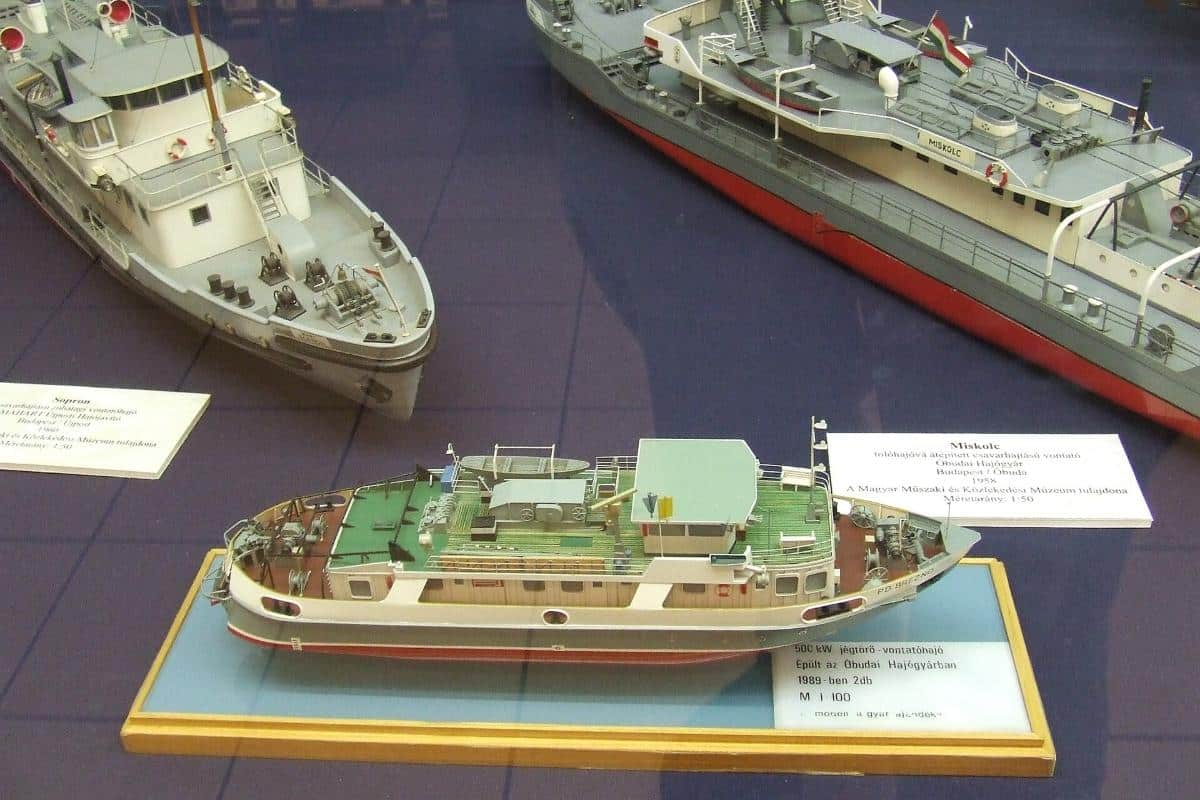
At that size a ship hull is about as long as a coffee table is wide. Rigging, deck fittings and railings can be modelled as individual parts instead of suggested with paint. The same logic applies to cars: for a 15-ft (180 in) car, 1:43 gives a 4.2-inch model, 1:24 gives 7.5 inches, 1:18 gives 10 inches, 1:12 gives 15 inches and 1:8 gives 22.5 inches. One customer on our custom car models page describes their custom Camaro as a 1:18 model about 10 inches long, with the custom wheels and rear window louvers reproduced. Each step up in scale buys more room for exactly that kind of detail.
Custom Ships and Yachts: A Hull That Matches the Space
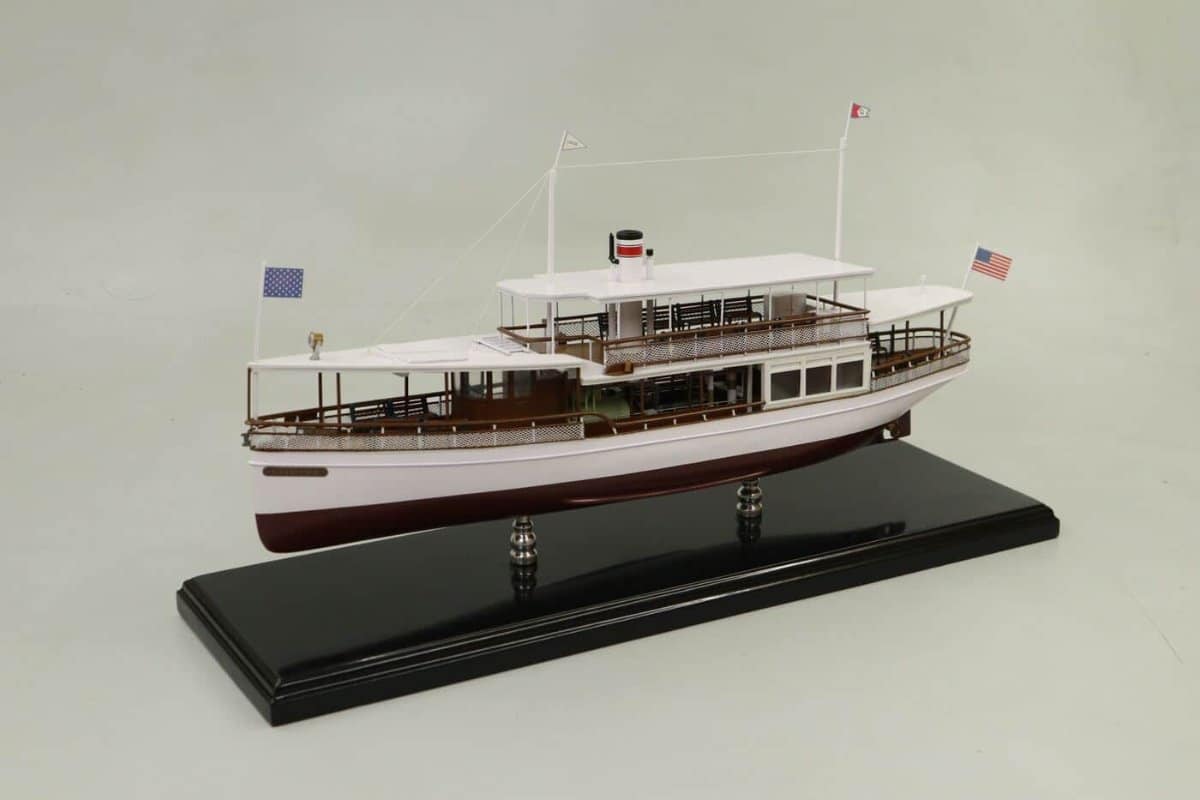
Ships are where custom sizing matters most, because real vessels range from a 40-foot launch to a 1,000-foot freighter. A scale that works for a yacht would make a freighter several feet long. For this reason, custom ship models are best sized around the display space first, with the scale worked out afterwards. A good starting point is to measure the shelf, case or table and tell us the longest dimension you can accept.
Big Models (1:20 to 1:10): Furniture-Sized, Built Like Structures
Once a model is longer than a person is tall, it stops being a collectible and starts behaving like an installation. Airports, museums and corporate lobbies use models at this size because visitors can see them from across a room. Our big model airplanes, large scale airplane models and giant-scale models pages show finished examples, and the large scale exhibition models page covers builds made for trade shows and displays.
The construction changes here, and the reason is arithmetic. Length scales linearly, surface area scales with the square and volume scales with the cube. This is the square-cube law. Going from 1:100 to 1:10 makes every length ten times bigger, every surface 100 times bigger and the volume 1,000 times bigger. Suppose a solid hardwood model weighs 2 pounds at 1:100. Built the same way at 1:10, it would weigh about 2,000 pounds.
Nobody builds a big model that way. Large builds are made as shells over internal frames. On our full-size P-51 build, fiberglass is laid into molds by hand, weighed as it goes and finished by hand-sanding, with foam forms shaping the parts that need internal openings. That is a different kind of work from carving a desk model, and it is why large models take a different quote, a different timeline and different shipping arrangements.
The Lesson From Langley’s Quarter-Scale Aerodrome
Scaling is not just multiplication, and the clearest case is more than a century old. Samuel Langley’s unpiloted Quarter-scale Aerodrome made two flights of 150 ft and 350 ft on June 18, 1901, and flew again on August 8, 1903. The full-size, piloted Aerodrome A was meant to be the same design at four times the size. It spanned nearly 50 feet and crashed on takeoff on October 7 and again on December 8, 1903.

The Smithsonian notes that the structural and control needs of a piloted aircraft were very different, so the small model hid flaws that only appeared at full size. A display model has an easier job, because it does not have to fly, but the principle carries over. A design that looks right at 1:100 may need extra internal structure at 1:10, and thin parts such as wingtips, antennas and landing gear need to be engineered for the size they are built at, not just shrunk or enlarged.
How to Choose the Right Size for Your Model
Work through these in order and the scale usually picks itself:
- Measure the space first. Write down the longest length, the depth and the height you can use, plus the doorways the model must pass through.
- Decide how it will be viewed. A model seen from 3 feet away can be 1:100. A model seen from across a lobby needs to be much larger to read at all.
- Pick the details that matter. If you want opening doors, an interior or individual rigging, you need a larger scale to hold them. If shape and livery are enough, a smaller scale will do.
- Run the numbers. Divide the real length by the scale, or use the scale calculator.
- Ask about timing and shipping. Our car models are built from your photos in 8 to 12 weeks. Large builds are quoted individually, and crating or freight can change the plan.
How to Commission a Custom Size Model
Send us photos and reference images of the aircraft, car or ship, along with the size you have in mind, on the how to order page. If you only know the space, give us the maximum dimensions and we will recommend a scale. You can also browse the gallery to see completed builds at many different sizes before you decide.
Frequently Asked Questions
What is the smallest and largest size you can build?
Our range runs from 1:500 desk pieces up to full-size 1:1 builds such as the P-51 Mustang in progress.
Can I ask for a size that is not a standard scale?
Yes. Give us a target length, such as 36 inches, and we work backwards to the scale. The calculator does the same sum.
Does a bigger model always show more detail?
It can hold more, but detail still depends on the reference photos and the build. A larger scale gives room for interiors, opening parts and individual fittings that a small scale cannot hold.
How do I convert a real length to model length?
Divide the real length by the scale number. A 70.7 m aircraft at 1:100 is 0.707 m, or about 27.8 inches.
Why does a bigger model cost more?
Volume grows with the cube of the scale, so materials, labor and shipping rise faster than the length does. That is why large pieces are quoted individually.
If you already know what you want to see in your space, tell the team at Modelworks Direct the size and we will take it from there.