

Helicopters aren’t supposed to be big. They’re supposed to be agile, responsive, and relatively compact. Push the size too far and everything fights back at once — weight, vibration, gearbox loads, fuel burn, structural stress. That’s why truly giant helicopters are rare.
But a few engineers decided “rare” wasn’t the same as “impossible.”
The result is a small, extraordinary club of rotorcraft that rewrote what vertical lift could actually mean.
Mil Mi-26 — The undisputed heavyweight

If there’s a king of heavy-lift helicopters, it’s the Mi-26. Nothing else in operational service comes close.
This Russian-built machine can lift around 20 tons externally. That’s not a marketing number. That’s been proven in real-world missions. Armored vehicles, construction equipment, downed aircraft, entire prefabricated structures — the Mi-26 has carried all of it.
Step inside the cargo bay and it feels less like a helicopter and more like a transport aircraft. Trucks can drive in. Pallets can be loaded like a freighter. Yet it still lifts vertically from remote, unprepared terrain.
It exists because the Soviet military needed to move heavy equipment into places where roads didn’t exist. Engineers delivered exactly that, with no compromise on scale.
Decades later, nothing has surpassed it.
Mil Mi-12 — The giant that went too far

Before the Mi-26, there was something even more extreme: the Mil Mi-12.
This was not a conventional helicopter design. It used two enormous rotors mounted on wing-like structures, each driven by its own set of engines. The goal was simple and ambitious: lift even more than the Mi-26 ever could.
And it worked. The Mi-12 still holds the world record for the heaviest payload ever lifted by a helicopter — over 44 tons.
So why don’t we see them flying today?
Because practicality caught up with ambition. The aircraft was complex, expensive, and operationally awkward. The missions it was designed for changed before it could enter service. Only two prototypes were built.
It remains one of the most astonishing “what if” aircraft in rotorcraft history.
CH-53K King Stallion — Western heavy lift, modernized

On the Western side, the CH-53K represents the upper edge of modern military heavy-lift capability.
It’s not as large as the Mi-26, but it’s among the most powerful helicopters currently in production. Designed for the U.S. Marine Corps, it can lift external loads exceeding 15 tons, even in hot, high, and hostile environments.
What makes it impressive isn’t just size. It’s the technology layered onto that size. Fly-by-wire flight controls. Advanced composite rotor blades. Modern avionics. Automated load handling. It’s a heavy-lift machine designed for contemporary warfare rather than Cold War logistics.
Different philosophy. Same brutal requirement: lift what others can’t.
CH-47 Chinook — Smaller than the giants, but legendary for a reason
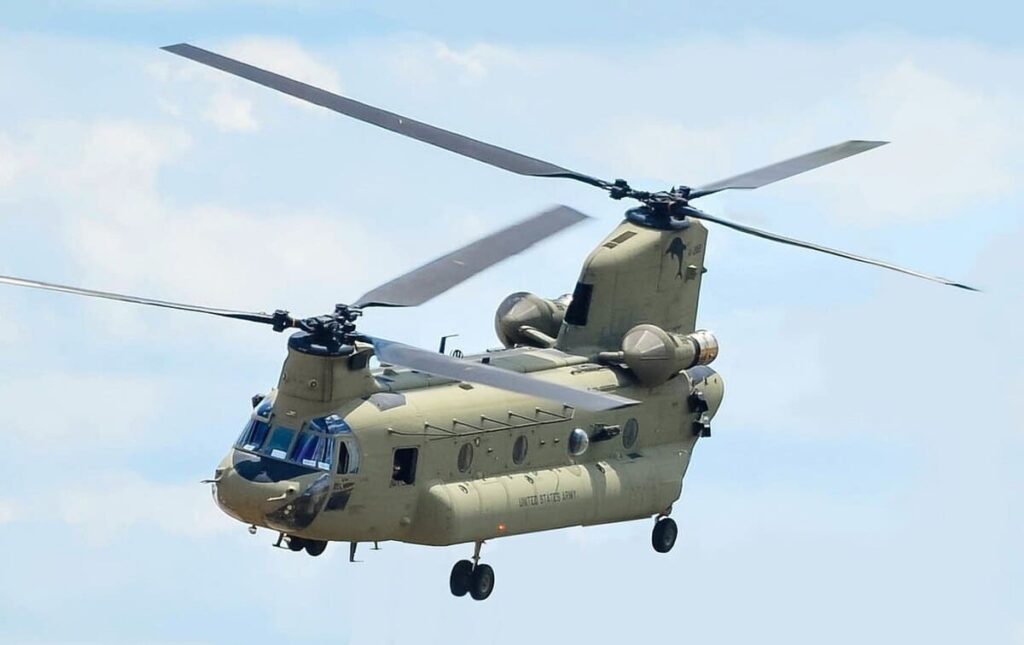
The Chinook doesn’t look massive next to an Mi-26. But within Western aviation, it’s long been the backbone of heavy transport.
Twin rotors. Huge internal volume. Exceptional reliability. The Chinook can lift around 10–12 tons, and it does so routinely, not as a special case. Artillery. Vehicles. Troops. Supplies. Disaster relief. It’s been everywhere.
What earns it a place on this list isn’t raw size. It’s longevity. Few helicopters have carried so much, so often, for so many decades.
Sometimes greatness isn’t about being the biggest once. It’s about being essential for generations.
Sikorsky S-64 Skycrane — The specialist lifter

The Skycrane looks strange even by helicopter standards. No real fuselage. Long legs. Exposed structure. Everything about it is built around one purpose: lifting external loads.
It can carry around 9 tons, which doesn’t sound extreme until you see what it actually lifts. Entire houses. Massive construction components. Firefighting tanks. Power line structures. Things that would be nightmares to move by any other method.
The S-64 is a reminder that size isn’t only measured in dimensions. It’s measured in capability.
Why helicopters don’t just keep getting bigger
You might wonder why, if the Mi-26 exists, we don’t simply scale up again and build even larger machines.
Because rotorcraft scaling is cruel.
As size increases:
- Structural loads rise dramatically
- Gearboxes become exponentially more complex
- Vibrations become harder to control
- Fuel consumption becomes extreme
- Maintenance becomes punishing
- Operational usefulness declines

The largest helicopters in the world exist right on the edge of where practicality still survives. Beyond that, you get prototypes, experiments, and record-setters that don’t make operational sense.
The Mi-12 proved what’s possible. The Mi-26 proved what’s usable.
Why these giants fascinate enthusiasts and collectors
Large helicopters don’t just impress because of numbers. They impress because they look like they shouldn’t work — and then they do.
Watching a Mi-26 lift something that looks heavier than the helicopter itself feels like watching physics bend slightly out of respect. That sense of mechanical audacity is why these aircraft hold such a strong place in aviation culture.

It’s also why they translate so powerfully into physical replicas. A detailed model plane of a giant helicopter like the Mi-12 or CH-53K isn’t just visually striking — it communicates scale in a way photos can’t. A custom airplane model, built with correct proportions and stance, makes people pause because their eyes instinctively register that something unusual is being represented.
Big machines carry presence, even at scale.