

For decades, aviation has lived with a shadow world running alongside it. Black budgets. Unmarked hangars. Flight plans that don’t exist. Aircraft that only appear as whispers in pilot forums or blurred triangles in night sky videos.
Every generation seems to produce one machine that breaks cover by accident.
Not officially unveiled.
Not rolled out with press invites.
Simply… seen.
And once seen, never quite unseen again.
The aircraft that wasn’t on any list
In the late 1980s, long before social media and smartphones, something strange started appearing in the skies over Nevada. Not on radar screens. Not in aviation magazines. But in eyewitness accounts from experienced observers: test pilots, aerospace workers, military personnel, civilian spotters who knew what a normal airplane looked like.
They described a large, dark, triangular aircraft.
No navigation lights.
Silent compared to jets.
Moving slowly, deliberately, almost unnaturally.

This wasn’t a conventional stealth fighter like the F-117, which the public didn’t officially know about until 1988. This was bigger. Stranger. Almost gliding.
People started calling it the TR-3A, the Astra, the Black Manta. None of those names were ever confirmed. That uncertainty became part of the story.
Why sightings clustered around one place
Almost every report pointed back to the same geography: southern Nevada. Groom Lake. The edges of the Nevada Test and Training Range. The place most people know as Area 51.
That alone didn’t prove anything. Lots of classified testing happens there. That’s the point of the place. But what made these sightings different was the consistency of description over time. Different people, different years, similar aircraft.

Long wings. Triangular planform. Unusual lighting patterns. Extremely quiet propulsion.
You can dismiss one witness. Hundreds get harder.
The technology that might explain the silence
Traditional jet aircraft are loud because they move a lot of air very violently. High-speed exhaust, shockwaves, mechanical noise. Silence doesn’t come naturally to high-performance aviation.
Unless you change the propulsion model.
Some aerospace engineers have speculated that these aircraft could have used hybrid propulsion: conventional turbines combined with electrically driven fans, or advanced turbofans optimized for low acoustic signature rather than speed. Others suggest extreme altitude flight, where distance itself masks sound.

No confirmed evidence exists. That’s the point. The silence is part of the mystery, and the secrecy surrounding propulsion technology is often tighter than secrecy around airframes.
Engines reveal capability. Capability reveals strategy.
Why the design matters even if the aircraft doesn’t exist
Here’s the uncomfortable truth for skeptics: even if every specific story is exaggerated, the concept itself is entirely plausible.
Stealth aircraft already prioritize shape over speed.
Surveillance platforms already trade performance for persistence.
Unconventional designs are already being flown under classification.

A large, slow, ultra-stealth reconnaissance aircraft designed to loiter undetected for long periods would make perfect strategic sense. More sense, arguably, than another fast strike platform.
You don’t need science fiction. You only need classified engineering priorities.
The moment secrecy started to fail
The difference between the 1980s and now isn’t technology. It’s visibility.
Today, everyone has a camera. Everyone has flight tracking apps. Everyone has access to satellite imagery. Secrecy is harder to maintain when thousands of independent observers are constantly recording the sky.
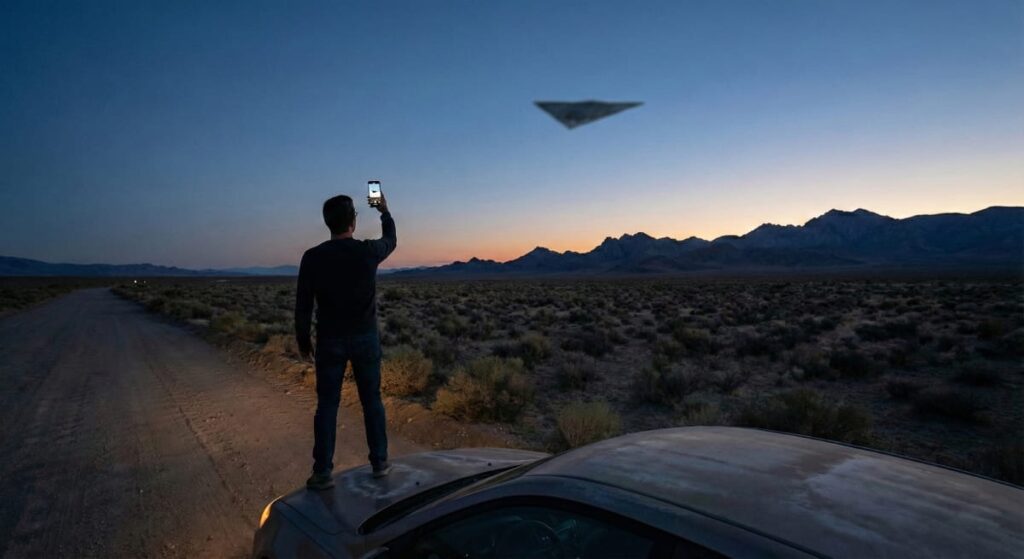
That’s why more recent sightings of unusual aircraft — odd silhouettes, unregistered transponders, unexplained test flights — tend to leak into public view faster. Not because governments became more transparent, but because the world became harder to hide from.
The secret plane era didn’t end. It just became more crowded with witnesses.
Why this kind of aircraft grips the imagination
Part of the fascination is technical. People who understand aviation know how hard it is to build something genuinely new. Radical shapes don’t fly easily. Unusual propulsion comes with enormous challenges. If something strange is flying, it suggests extraordinary engineering behind it.
But part of it is psychological.
These aircraft represent the boundary between what we’re allowed to know and what exists beyond public awareness. They sit at the edge of the map, like blank spaces once did on old charts.

Collectors and aviation historians feel this deeply. A model plane of a known stealth aircraft like the F-117 or B-2 already feels like a study in secrecy turned visible. A custom airplane model of an experimental, lesser-known prototype becomes even more compelling. It represents not just an aircraft, but a question. A challenge. A reminder that aviation history includes chapters we haven’t read yet.
The truth is probably quieter than the rumors, and more impressive
There probably isn’t an alien triangle silently patrolling the desert. That part belongs to late-night radio.
What is far more likely is this: advanced aircraft programs exist that we won’t learn about for decades, if ever. They fly in limited numbers. They operate in controlled airspace. They’re designed for missions the public doesn’t need to understand.
That’s how military aviation has always worked.
The U-2 flew in secret.
The SR-71 flew in secret.
The F-117 flew in secret.
Each time, the public thought the stories sounded too strange to be real.

Each time, the stories turned out to be understated.
The “secret plane nobody was supposed to see” isn’t one aircraft. It’s a category. A pattern. A reminder that above our heads, occasionally, something flies that exists years ahead of what we’re told is possible.
And every now and then, someone looks up at exactly the wrong moment and catches a glimpse of it.
Just long enough for the story to begin.