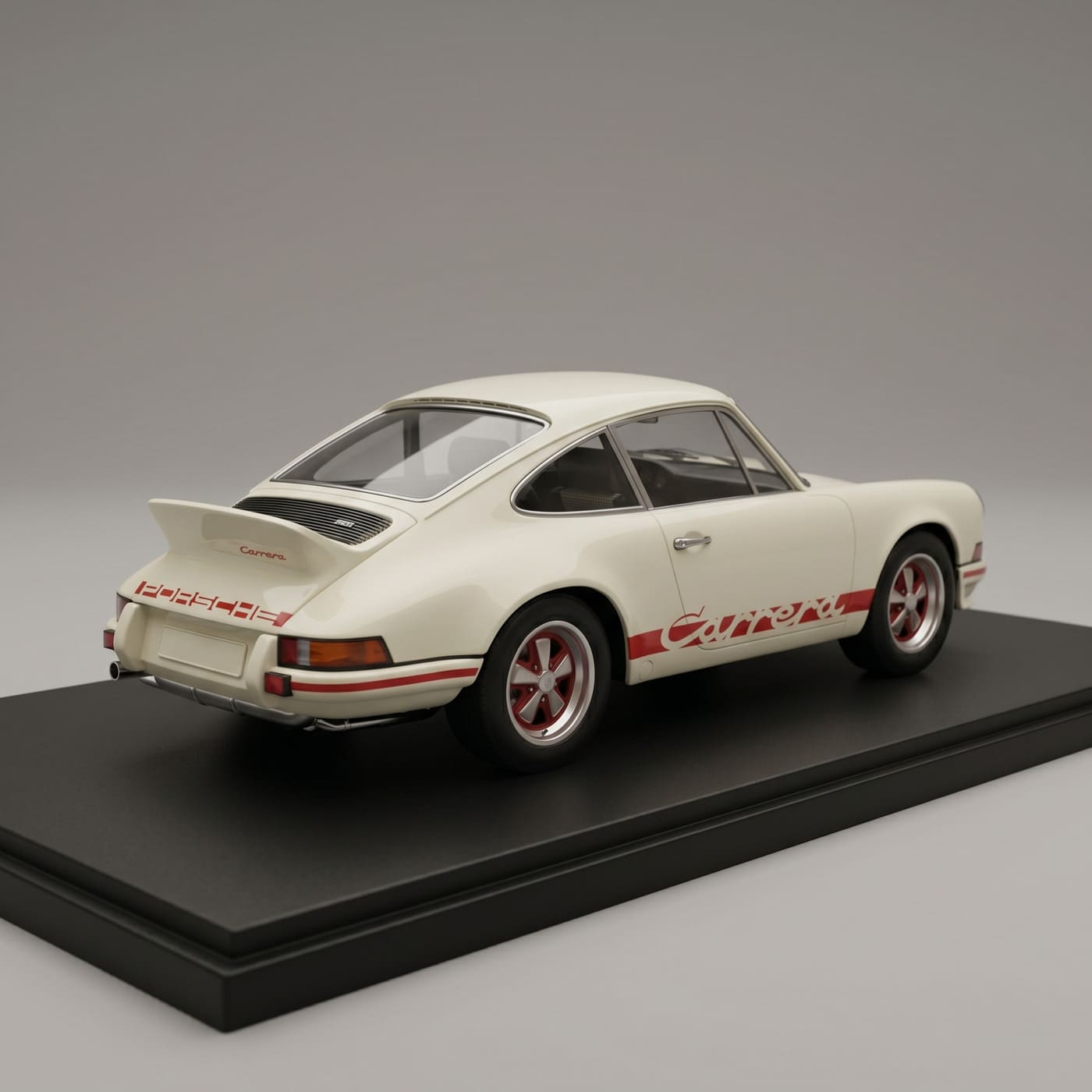
A Porsche 911 RS model is a display piece built around the 911 against which every high-performance Porsche since has been judged — the 1973 Carrera RS 2.7, the car that established the RS bloodline that runs directly through every GT3 RS and GT2 RS produced today. Unveiled to the world at the Paris Motor Show on 5 October 1972, this was not only the first 911 to wear the Carrera name, but the first Porsche to be christened RS — for Renn Sport, German for “racing sport.” Only 1,580 were built. Sport Lightweight versions now command upwards of $2.4 million at auction. And the Grand Prix White with red “Carrera” script, red Fuchs alloys, and ducktail rear spoiler captured in our reference model is the most iconic livery in 911 history — the combination that made the Carrera RS 2.7 the most recognizable air-cooled Porsche ever produced. A handcrafted scale replica preserves that icon in a display piece built to the standard this legendary car deserves.
The Homologation Special That Became a Legend
The Porsche 911 Carrera RS 2.7 was born from competitive frustration. In early 1972, Porsche’s managing director Ernst Fuhrmann watched BMWs and Fords outpacing 911s at Hockenheim and issued a direct challenge to his engineering team: fix it. The solution was a homologation special — a road car built in sufficient numbers to qualify the platform for FIA Group 4 competition, with every performance modification the regulations would allow. Porsche initially planned to build 500 examples. By the end of November 1972, all 500 had sold. Porsche was surprised by the car’s success and was able to triple the sales figures by July 1973. The sales department that had been terrified of selling 500 stripped-out race cars for the road ended up building 1,580 of them.
At the core of the RS sat a 2,687cc air-cooled flat-six with Bosch mechanical fuel injection, Nikasil-coated cylinder walls, and 210 horsepower at 6,300 rpm — the only radical mechanical change from the 2.4S on which it was based, yet the very capacity stretch that achieved the 207bhp power figure. The body was lightened with an aluminum engine lid, thinner gauge steel panels, and thinner glass. The 1973 Carrera RS was the first Porsche production model to feature a staggered wheel setup, with wider rear wheels than front — requiring the rear bodywork to be widened by 42mm at the wheel arches. The result weighed as little as 960kg in Lightweight specification and reached 150mph from a 2.7-liter engine that had started life as a road car unit. The ducktail spoiler — developed in the wind tunnel by engineer Tilman Brodbeck after colleagues laughed at the idea — reduced rear-end lift so effectively that it became the defining visual element of the entire RS lineage.
Grand Prix White, Red Fuchs, Red Script — The Definitive RS Livery
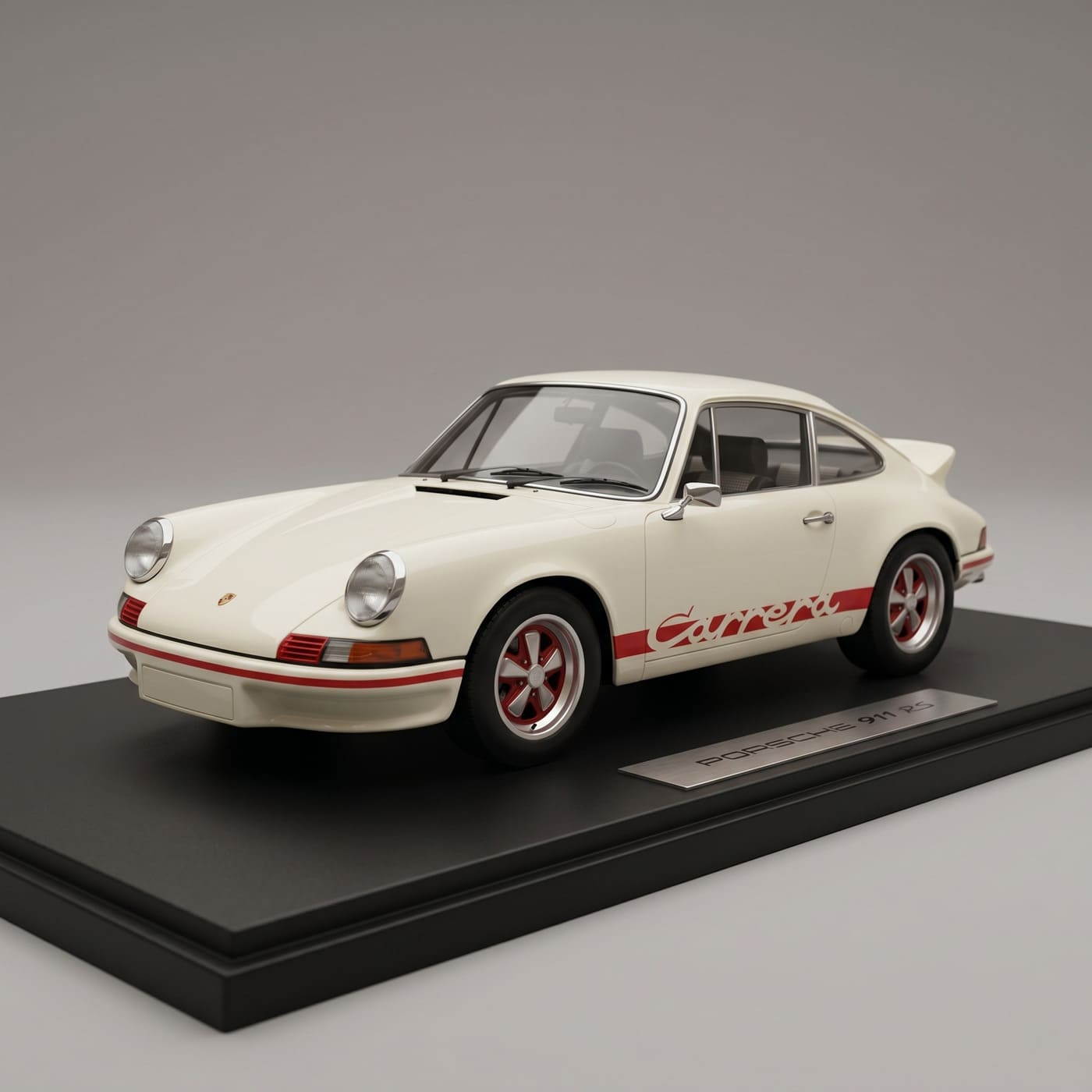
The model in our reference image captures the most celebrated color combination in 911 history: Grand Prix White (factory code 908) with red “Carrera” script running the length of the rocker panels, color-matched red Fuchs forged aluminum alloy wheels, and red accent trim — the exact specification worn by the RM Sotheby’s consigned Lightweight example documented in its original Porsche Fahrzeug-Auftrag as “Grand Prix White with red exterior lettering.” Our craftsmen reproduce every detail of this iconic presentation — the bold Carrera script in its period-correct cursive typeface, the Fuchs wheel spoke pattern with its red painted centers and polished rims, the ducktail rear spoiler in its correct fiberglass construction, the chrome round headlights, the engine lid intake vents, and the engraved “Porsche 911 RS” nameplate on the matte black display base — exactly as captured in our reference photographs.
The RS was available from the factory in Grand Prix White, Light Yellow, Gulf Orange, Viper Green, and Blood Orange — each with contrasting Carrera script and Fuchs wheel color options that made every RS immediately identifiable as something apart from the standard 911 range. We build any factory color combination to your specification, with the script color, wheel finish, and interior trim of your chosen variant.
Sport Lightweight, Touring, and RSR — Every RS Variant Available
The 1,580 Carrera RS 2.7s were not a single homogeneous production run — they comprised three distinct configurations that collectors and historians treat as entirely separate propositions. The optional M471 equipment package led to Porsche building 200 lightweight Sport versions. A further 55 examples of the racing version, 17 base vehicles, and 1,308 Touring versions were built. The Sport Lightweight — stripped of every non-essential item including the glove box door, passenger sun visor, coat hooks, undercoating, and rear seats — is the most focused and most valuable of the three. The Touring (M472) added back the 911S interior trim for buyers who wanted the RS’s performance without its austerity. And the RSR competition version — with its 2.8-liter engine producing 300 horsepower — won at Daytona, Sebring, and the Targa Florio in its debut season. Our craftsmen build all three configurations to the exact specification you require.
- Fully handcrafted — no kits, no mass-produced parts
- Sport Lightweight (M471), Touring (M472), and RSR competition specifications all available
- Grand Prix White/red, Light Yellow, Gulf Orange, Viper Green, and Blood Orange factory colors
- Period-correct Fuchs wheel finish and Carrera script color matching accurately reproduced
- Ducktail spoiler, chrome headlights, engine lid vents, and staggered wheel stance faithfully captured
- Engraved nameplate on matte black display base included as shown
- Ideal for Porsche collectors, air-cooled 911 enthusiasts, RS historians, and premium gifting
Part of Our Custom Car Model Collection
The Porsche 911 RS sits alongside classic racing cars, European sports car legends, and automotive icons in our custom car models collection. From the air-cooled 911 that defined performance Porsche to the most celebrated modern GT cars — if it drives, we build it.
Build My Aircraft Model from Photos

 ❮
❯