

There’s a particular kind of awe you feel standing on a pier while a massive ship slides past. Not the flashy kind. Something heavier. Slower. More primal. These are machines that don’t just move through water — they displace it, reshape it, dominate it.
Speed and size rarely coexist in ship design. Naval architects usually have to choose. You build something enormous, or you build something fast. The vessels that manage to flirt with both extremes tend to become legends.
Here are ten ships that earned that status, not because of marketing, but because of what they physically proved was possible.
1. Seawise Giant – The largest ship ever built
Length: 458.5 meters
Deadweight: over 560,000 tons
Top speed: around 16 knots

Seawise Giant wasn’t built for speed and never pretended to be. At full power, it could manage roughly 16 knots, which feels slow until you remember the scale. Turning it took miles. Stopping it took planning.
Seawise Giant (later known as Jahre Viking) remains the largest moving object ever constructed by humans. Fully loaded, it had a draft so deep it couldn’t pass through the English Channel, the Suez Canal, or the Panama Canal. It simply went around continents.
It wasn’t graceful. It wasn’t fast. It was pure scale. Watching footage of it docking feels like watching geography shift.
2. Emma Mærsk – The container ship that redefined logistics
Length: 397 meters
Top speed: about 25–26 knots

For a ship of this size, that speed is impressive. Emma Mærsk helped define the ultra-large container vessel era. These ships are designed to move enormous volumes efficiently, not quickly — yet they still cruise faster than most people expect. They look slow. They’re not.
When Emma Mærsk entered service, it quietly changed global shipping. More containers per voyage meant fewer ships overall, which meant lower costs and a restructuring of trade routes. These ultra-large container vessels look like floating cities, and in many ways they are.
They’re also engineering exercises in balance. Stack too high, load incorrectly, misjudge the stress, and things go wrong quickly.
3. Symphony of the Seas – A floating metropolis
Length: 361 meters
Passengers: over 6,600
Top speed: around 22 knots

A vessel carrying over 6,600 passengers, complete with parks, theatres, and neighborhoods, has no business moving this smoothly. And yet it does.
Cruise ships are all about stability. The challenge isn’t speed; it’s keeping a skyscraper stable in rolling seas while maintaining schedules across oceans.
Calling this a “ship” almost feels outdated. It’s closer to a mobile city. Parks onboard. Ice rinks. Theatres. Entire neighborhoods. From an engineering perspective, what’s impressive isn’t the luxury. It’s stability. Keeping something this top-heavy safe in rough seas is no small feat.
Bigger cruise ships exist now, but Symphony marked a turning point in just how far that ambition could be pushed.
4. USS Gerald R. Ford – The largest warship ever commissioned
Displacement: over 100,000 tons
Top speed: estimated 30+ knots

Aircraft carriers are massive, but they’re not slow. A nuclear-powered carrier like USS Gerald R. Ford can outrun most surface vessels when required. That speed isn’t about spectacle. It’s about launching aircraft into wind, repositioning quickly, and staying unpredictable.
Size here isn’t about excess. It’s about endurance.
5. Francisco – The fastest passenger ferry
Top speed: 58 knots
Top speed: about 58 knots (over 107 km/h)

This Argentine-built catamaran ferry is genuinely fast. Carrying more than 1,000 passengers and still hitting nearly 60 knots is no small feat. At those speeds, hull design becomes brutally unforgiving. Every inefficiency shows.
Fast ships are unforgiving. Hull design becomes everything. At these speeds, water behaves less like water and more like resistance you’re constantly negotiating.
6. Destriero – The fastest transatlantic crossing by motor yacht
Top speed: 66 knots
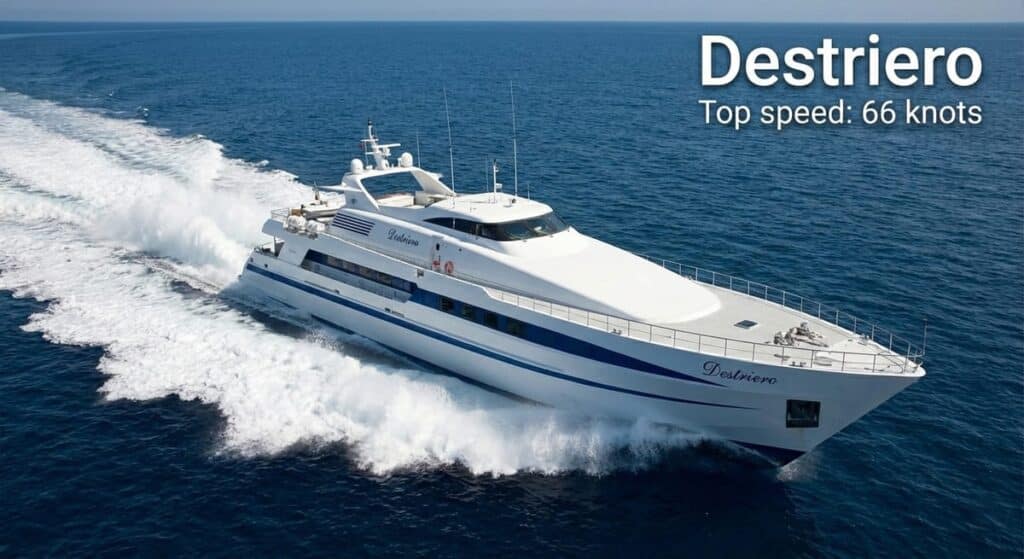
In 1992, Destriero crossed the Atlantic faster than any ship before it, averaging over 53 knots. This wasn’t a military project. It wasn’t a government experiment. It was privately built, obsessively engineered, and focused on one goal: speed.
It proved that careful hydrodynamics and relentless attention to detail could rival institutional budgets.
7. Prelude FLNG – The largest floating structure ever built
Length: 488 meters
Top speed: roughly 7–8 knots (when under tow)

Prelude is not about speed. It’s about scale. It’s essentially a floating industrial plant that happens to live at sea. When it does move, it moves slowly, deliberately, and with an escort.
Calling it a ship almost feels inadequate. It’s closer to a mobile offshore city.
8. HSC HSV-2 Swift – Military speed above all
Top speed: 50+ knots

This experimental high-speed vessel showed what happens when you prioritize velocity for military logistics. Lightweight construction. Aggressive hull design. Minimal tolerance for inefficiency. It could deploy troops and equipment far faster than conventional ships, but at the cost of complexity and maintenance.
Much like experimental aircraft, experimental ships reveal both potential and limits.
9. Oasis of the Seas – The ship that made “largest” mainstream
Length: 360 meters
Top speed: about 22 knots

Oasis didn’t just break records. It normalized excess scale. After it, the cruise industry recalibrated what “big” meant. These ships are so vast that they require their own traffic planning when entering ports.
From a design perspective, the challenge is less about size and more about flow. People, supplies, waste, energy. Everything must move smoothly, or the illusion collapses.
10. SS United States – The fastest large ocean liner ever
Length: 302 meters
Top speed: officially over 38 knots
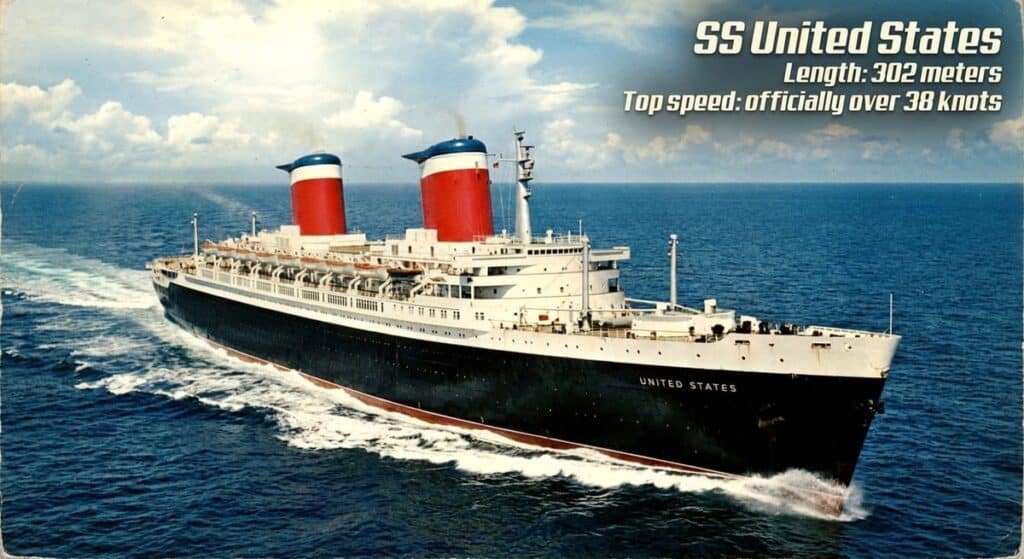
SS United States still holds the Blue Riband for the fastest transatlantic crossing by an ocean liner. Built in the 1950s, with military assistance, its true top speed remains partly classified. Engineers designed it so it could be converted into a troopship if needed.
Fast. Overbuilt. Politically strategic.
A ship with Cold War urgency baked into its hull.
Why these ships stay with us
The fastest and biggest ships in the world endure in memory for the same reason iconic aircraft do. They represent moments when engineers were allowed to chase ambition without trimming every edge for efficiency.
For enthusiasts and collectors, these vessels carry real character. A museum-quality replica of a ship like Seawise Giant, SS United States, or even Francisco doesn’t just show proportions. It reveals intent. Hull lines, superstructure choices, and design compromises become obvious in physical form in a way photos never quite capture.

Ships like these remind us that engineering isn’t only about solving problems. Sometimes it starts with a dangerous question:
How big?
How fast?
How far can we push this before physics pushes back?