The North American P-51 Mustang Aircraft Model represents one of the most decisive fighter designs of the Second World War, an aircraft whose influence was measured not just in victories, but in survival. The Mustang emerged from an urgent operational need rather than a long design cycle, yet it matured into a machine that fundamentally changed the balance of air combat. For those who flew alongside it, the P-51 was not simply fast or agile. It was dependable over distance, and that mattered.
Aircraft Background and Operational Purpose
The P-51 Mustang was originally conceived as a response to a British requirement for a modern fighter, but its true potential was realized after the integration of the Rolls-Royce Merlin engine. That pairing transformed the aircraft into a long-range escort fighter capable of operating at high altitude with sustained performance. This combination allowed Allied bombers to be protected deep into enemy territory, a capability that had been lacking earlier in the war.
Aerodynamically, the Mustang was ahead of its time. Its laminar-flow wing reduced drag at cruise speeds, while the fuselage design emphasized efficiency and balance rather than brute strength. The result was an aircraft that could fly farther, faster, and longer than most of its contemporaries. Broader historical and technical background can be found through the North American P-51 Mustang, which documents its development and wartime service.
- Long-range escort fighter developed for sustained bomber protection
- Merlin engine enabling high-altitude performance and endurance
- Laminar-flow wing designed to reduce drag and improve efficiency
- Widely deployed across European and Pacific theaters
Why the P-51 Mustang Matters
The importance of the P-51 Mustang lies in its strategic effect rather than individual engagement statistics. By enabling continuous fighter escort, it reduced bomber losses and disrupted opposing air defenses at a critical stage of the war. This shift had direct consequences on campaign outcomes and accelerated the path toward Allied air superiority.
Beyond wartime service, the Mustang’s design influenced postwar fighter development and remained relevant long after hostilities ended. Its continued presence in air racing and heritage operations reflects the strength of its original engineering.
Scale Representation and Aerodynamic Accuracy
As a scale subject, the North American P-51 Mustang Aircraft Model demands precise handling of aerodynamic lines. The wing profile, fuselage curvature, and tail geometry must be exact to preserve the aircraft’s unmistakable appearance. Even small deviations in canopy shape or wing thickness are immediately apparent to experienced observers.
- Accurate laminar-flow wing profile and planform
- Correct fuselage contours and canopy proportions
- Faithful landing gear stance and wheel positioning
- Restrained surface detailing consistent with operational aircraft
Craftsmanship and Build Discipline
Each North American P-51 Mustang Aircraft Model is built by hand, beginning with careful study of reference drawings and period photographs. Structural geometry is established early, ensuring wing incidence, fuselage alignment, and tail placement remain true to the original design before finishing begins.
Detailing is applied with restraint. Panel lines remain subtle, surface transitions are smooth, and finishes reflect aircraft as they appeared in service rather than restored showpieces. The objective is authenticity grounded in operational reality.
Customization and Display Options
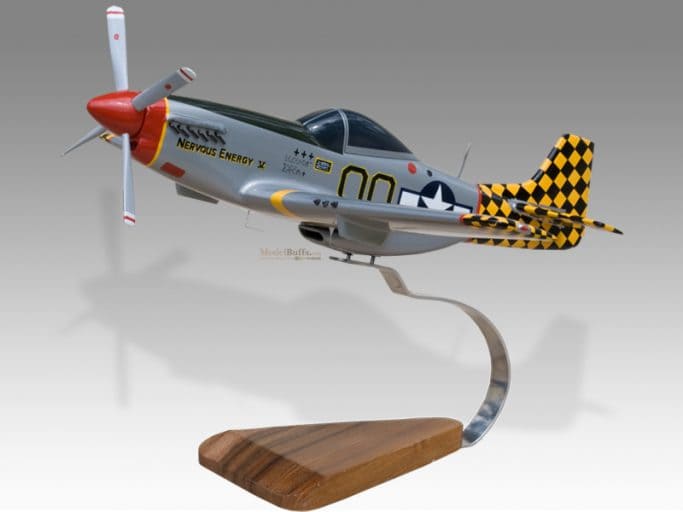
The North American P-51 Mustang Aircraft Model can be customized to represent specific squadrons, individual aircraft, or operational periods. Scale selection is guided by display environment, while markings and finishes are developed from documented wartime references to ensure historical accuracy.
- Custom scale selection for museum, office, or private display
- Authentic wartime squadron markings and nose art
- Period-correct paint schemes and configuration details
- Display bases with engraved identification plaques
Who Commonly Commissions This Model
This model is frequently commissioned by military aviation museums, historians, veterans’ families, and collectors focused on World War II aircraft. It is also selected by organizations seeking to represent the strategic air power that defined mid-twentieth-century conflict.
In every setting, the North American P-51 Mustang Aircraft Model stands as a measured representation of engineering discipline, operational necessity, and the realities of wartime aviation.
Build My Aircraft Model from Photos

 ❮
❯
❮
❯