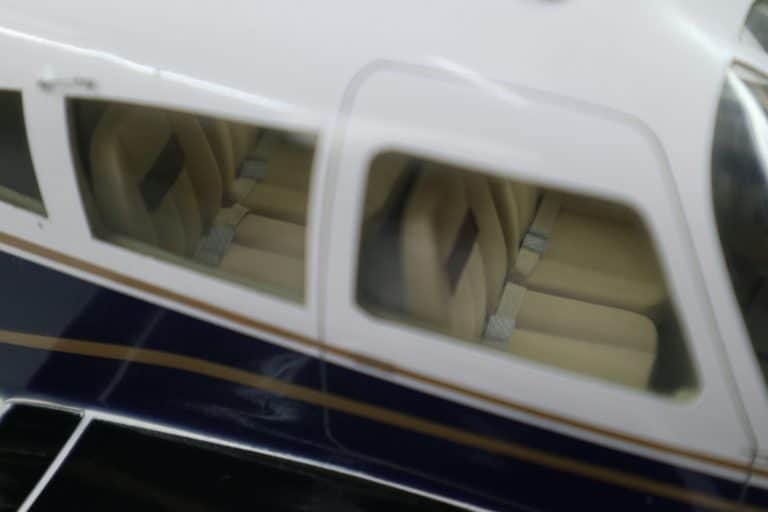
The Piper Challenger Airplane Model represents a brief but telling chapter in light aircraft development, one shaped by shifting economics rather than aerodynamics alone. Introduced during the late 1970s, the Challenger was Piper’s response to a changing training and personal aviation market, where cost control and simplicity had become as important as performance. Though its production run was short, the aircraft reflects a moment when manufacturers were forced to rethink how light airplanes were designed, built, and sold.
Aircraft Background and Design Intent
The Piper Challenger was developed as a lightweight, economical two-seat aircraft intended primarily for flight training and personal use. Unlike earlier Piper designs rooted in traditional construction methods, the Challenger explored new approaches aimed at reducing manufacturing costs while maintaining acceptable handling characteristics. This included simplified structures and materials chosen with efficiency in mind.
Although the program ultimately faced certification and business challenges, the aircraft itself demonstrated stable, predictable flight behavior suited to basic training. Its high-wing configuration provided good visibility and inherent stability, aligning it with the expectations of student pilots and instructors. Additional historical context can be found through the Piper PA-38 program history, which outlines Piper’s broader efforts during this period of transition in general aviation.
- Two-seat light aircraft developed for training and personal flying
- Design emphasis on cost efficiency and simplified construction
- High-wing configuration supporting stability and visibility
- Representative of late-1970s general aviation market pressures
Why the Piper Challenger Matters
The significance of the Piper Challenger lies less in widespread adoption and more in what it represents historically. It illustrates how external factors such as liability costs, fuel prices, and regulatory pressures influenced aircraft design decisions. For aviation historians, the Challenger serves as a reference point for an industry adapting under constraint.
Though relatively few were built, the aircraft remains relevant as an example of experimentation during a difficult period for light aircraft manufacturers. Its story adds context to why certain designs endured while others quietly disappeared.
Scale Representation and Visual Accuracy
As a scale subject, the Piper Challenger Airplane Model requires careful attention to proportion and stance. Its compact fuselage, modest wingspan, and straightforward landing gear geometry leave little margin for distortion. When accurately represented, the model conveys the aircraft’s utilitarian, purpose-driven character.
- Accurate high-wing placement and wing-to-fuselage proportions
- Correct landing gear stance reflecting real ground attitude
- Balanced tail geometry consistent with the original design
- Restrained surface detailing appropriate to training aircraft
Craftsmanship and Build Approach
Each Piper Challenger Airplane Model is built by hand with an emphasis on dimensional accuracy before any surface finishing begins. Reference photographs and available specifications are used to establish the airframe’s proportions and geometry. This ensures the model reads correctly from all viewing angles.
Finishing is applied conservatively. Panel lines remain subtle, edges are clean, and the overall presentation reflects an aircraft in service rather than a stylized interpretation. The objective is authenticity rooted in context.
Customization and Display Options
The Piper Challenger Airplane Model can be customized to represent specific aircraft, training environments, or period-correct liveries. Scale selection is guided by the intended display setting, while markings are developed from documented references to ensure historical consistency.
- Custom scale selection for home, office, or educational display
- Authentic civilian or training paint schemes
- Registration markings matched to real aircraft
- Optional display bases with engraved identification plaques
Who Commonly Commissions This Model
This model is typically commissioned by aviation historians, training organizations, museums, and private collectors interested in lesser-known general aviation aircraft. It is also selected by individuals who trained or instructed during the period when the Challenger was introduced.
In every context, the Piper Challenger Airplane Model serves as a thoughtful representation of an aircraft shaped as much by economic reality as by aerodynamic design.
Build My Aircraft Model from Photos

 ❮
❯
❮
❯