 ❮
❯
❮
❯

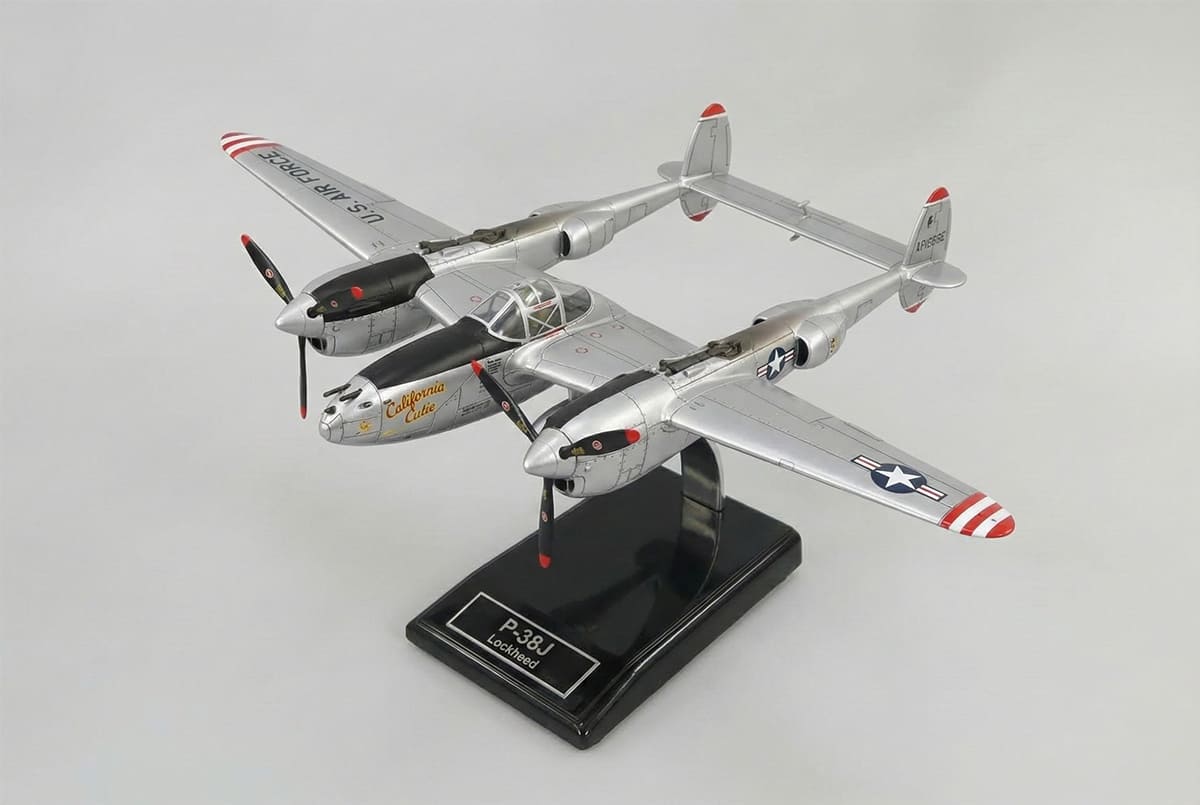
Lockheed P-38 Lightning Aircraft Model
- Material: Mahogany
- Finish: Hand-painted
- Base: Wooden stand
The Lockheed P-38 Lightning Aircraft Model represents an aircraft that never fit comfortably into any single category. It was a long-range escort, a high-altitude interceptor, a ground-attack platform, a reconnaissance workhorse, and—perhaps most importantly—a machine that rewarded disciplined pilots while punishing careless ones. Among historians and experienced builders, the P-38 is often described as one of the most intellectually interesting fighters of the Second World War. Its twin-boom layout, compressibility challenges, and technical ambition give it a depth that goes far beyond its unmistakable silhouette. This handcrafted Lockheed P-38 Lightning Aircraft Model is built to honor that complexity, not simplify it.
The P-38, “Lightning,” and Lockheed’s Most Ambitious Fighter
Officially designated the P-38 Lightning, the aircraft earned its nickname long before it entered widespread combat service. It looked fast standing still, and for much of the early war it was among the few Allied fighters capable of operating effectively at altitude and range. Designed around two Allison V-1710 engines with turbo-superchargers, the P-38 achieved performance figures that were exceptional for the late 1930s when the concept first took shape. It was not a conventional aircraft and was never meant to be. Clarence “Kelly” Johnson’s design team at Lockheed pursued efficiency, stability, and heavy armament through engineering solutions that were considered unconventional at the time.
The result was a fighter with concentrated nose-mounted firepower, eliminating convergence issues common to wing-mounted guns, and a platform capable of extremely long missions across the Pacific. The type’s role in operations such as the interception of Admiral Yamamoto’s aircraft in 1943 alone would secure its place in aviation history. Technical background on the aircraft’s development and variants is well documented in the Lockheed P-38 Lightning history, while operational context and surviving examples are explored through institutions such as the National Museum of the U.S. Air Force P-38 profile.
Why the P-38 Lightning Demands Serious Treatment as a Model
The P-38 is one of those aircraft that instantly exposes careless modeling. The proportions between the central nacelle and the twin booms must be precise. The angle and thickness of the wing, the geometry of the tailplane connecting the booms, and the distinctive shape of the cockpit canopy all define whether the model feels authentic or artificial. This is not a forgiving subject. That is exactly why experienced collectors and aviation professionals value a well-executed Lightning.
Visually, the aircraft carries presence. The wide stance, long nose, and twin vertical fins give it a purposeful, almost architectural quality. When built correctly, the Lockheed P-38 Lightning Aircraft Model does not resemble any other fighter on the shelf. It stands apart, just as the real aircraft did on wartime ramps.
Craftsmanship Focused on Geometry, Not Gimmicks
A credible P-38 model is built from the inside out, even when the internal structure is not visible. Boom alignment, wing incidence, canopy profile, and propeller scale must all be resolved before surface finish ever becomes relevant. Each Lockheed P-38 Lightning Aircraft Model is developed using careful reference study to preserve those relationships. The aim is that the aircraft should “read correctly” even to someone who has spent decades studying wartime photography.
Surface finish follows the reality of operational aircraft. Many Lightnings flew in natural metal, others in olive drab and neutral gray, later examples in bare aluminum with squadron markings. Weathering, panel definition, and markings are handled with restraint so the model feels like a scaled aircraft rather than a stylized artifact. Clients who explore other historically accurate aviation projects can view our wider collection of custom aircraft models, where the same approach to proportion and research guides every build.
Customization That Reflects Real Squadrons, Real Aircraft, Real Histories
Commissions for a Lockheed P-38 Lightning Aircraft Model are often tied to specific aircraft histories. Some clients request replicas of famous machines flown by aces such as Richard Bong or Thomas McGuire. Others commission models representing family service connections, museum exhibits, or commemorative displays. Scale can be adapted for private collections, institutional exhibits, or corporate environments.
Markings can be reproduced to reflect specific squadrons, theaters, and periods of service, from Pacific-based long-range escorts to European theater reconnaissance variants. Display bases can remain minimal or include engraved plaques, unit insignia, and historical notes. For deeper historical perspective on how the P-38 shaped Allied airpower, resources such as the Air & Space Forces Magazine P-38 retrospective offer valuable insight into the aircraft’s long-term significance.
Who Typically Commissions This Model
The Lockheed P-38 Lightning Aircraft Model is most often commissioned by military aviation historians, veterans’ families, serious collectors of WWII aircraft, aviation museums, and educational institutions. It appeals strongly to those who value engineering depth and historical authenticity rather than surface-level recognition. These are usually models commissioned with intention, not impulse.
Preserving One of Aviation’s Most Intellectually Ambitious Fighters
The P-38 was not designed to be ordinary, and it was never flown that way. A carefully executed Lockheed P-38 Lightning Aircraft Model preserves the identity of an aircraft that challenged conventions and expanded what a fighter could be. It stands as a tribute to engineering ambition, operational courage, and a design that still commands respect decades after its last combat sortie.
Testimonials

Known & Trusted by