 ❮
❯
❮
❯
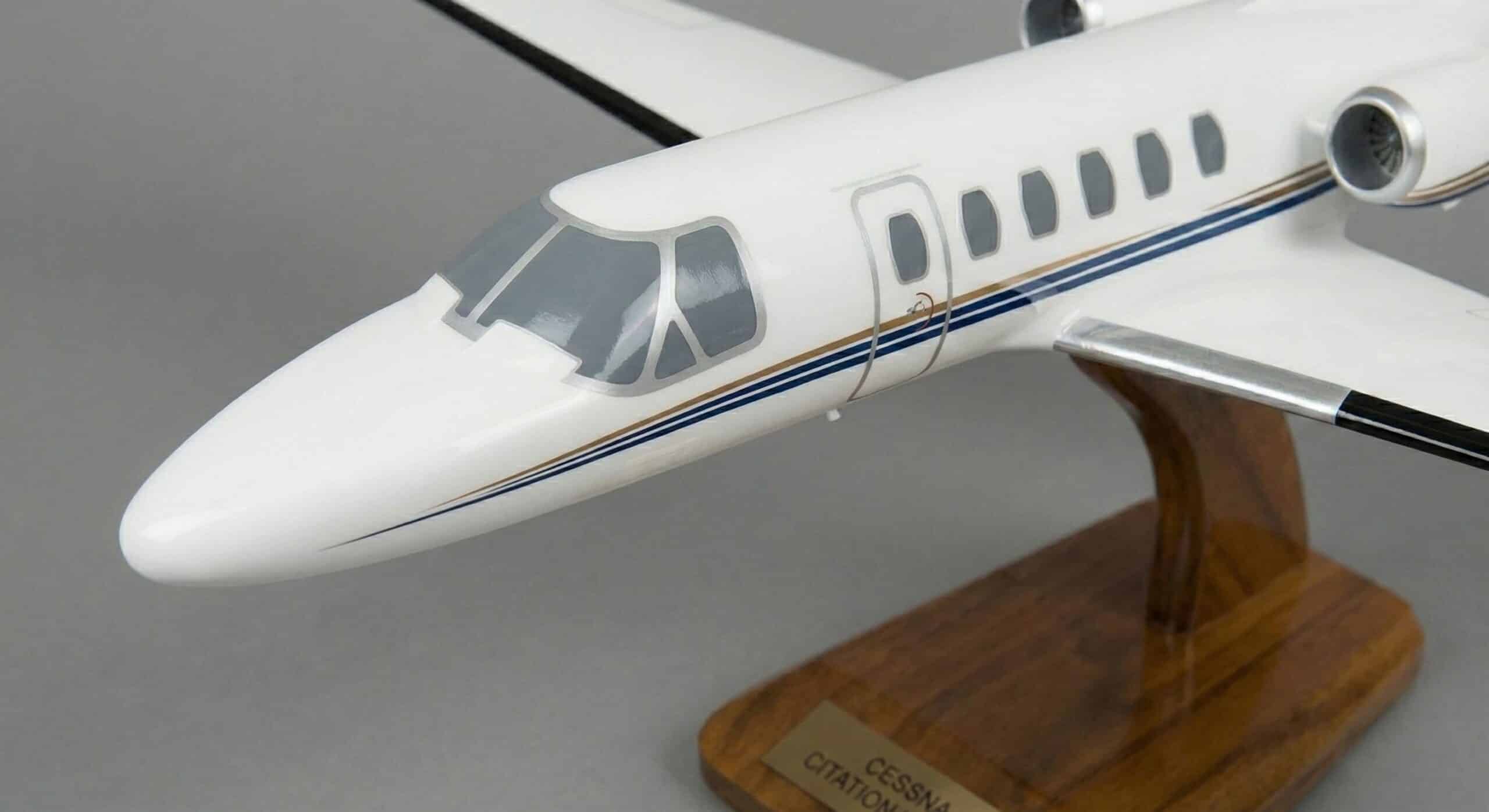
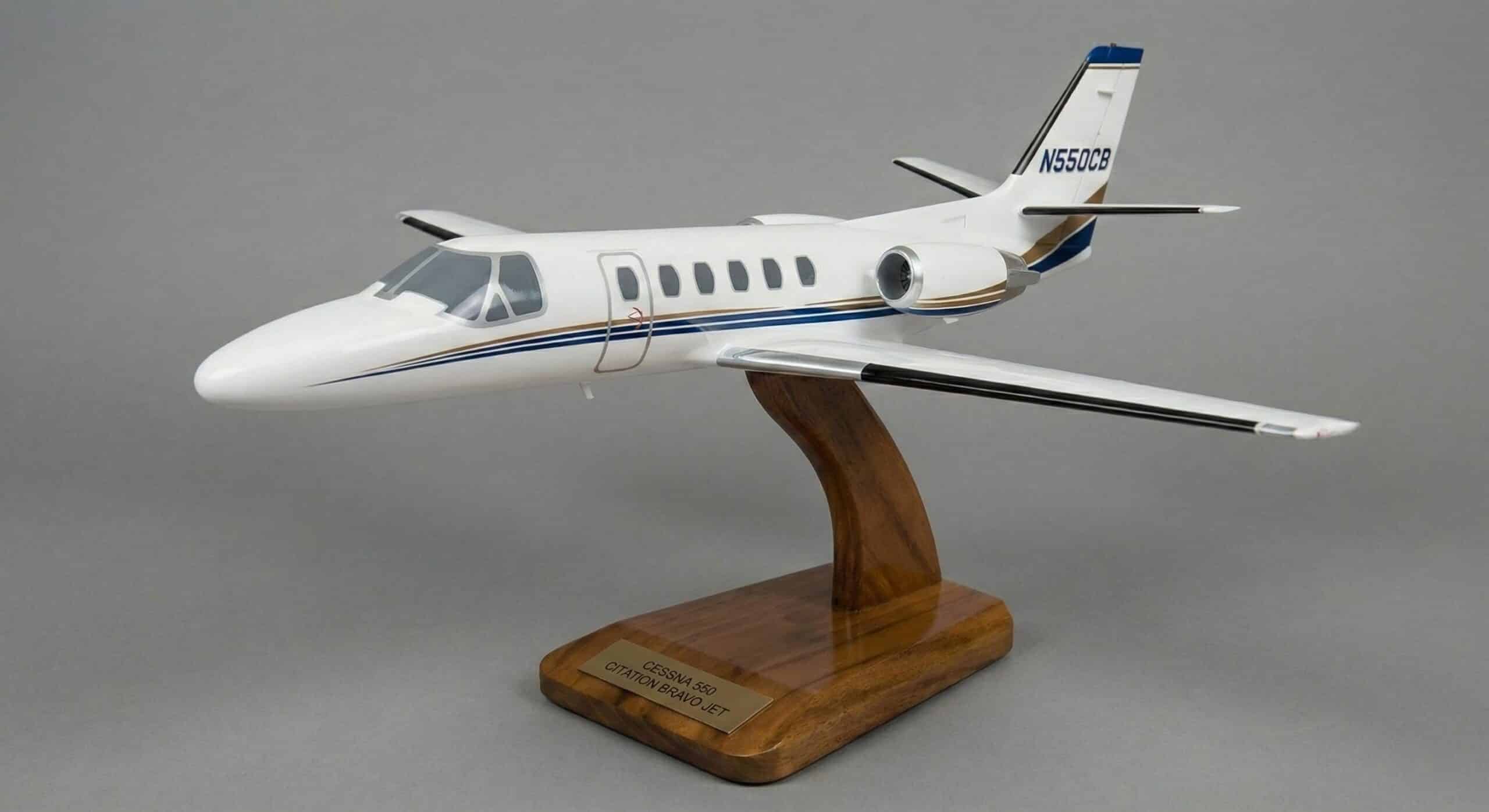
Cessna 550 Citation Bravo Jet Model
- Material: Mahogany/Balsa/Resin/Plastic/Diecast
- Finish: Hand-painted
- Base: Wooden/Plastic stand
The Cessna 550 Citation Bravo Jet Model represents one of the most refined evolutions of the original Citation concept. The Bravo was not designed to be dramatic. It was designed to be dependable, efficient, and quietly professional. Among pilots and business aviation operators, the Citation Bravo earned its reputation through consistency rather than spectacle. A well-executed model plane of this aircraft carries that same character — disciplined, balanced, and purposeful rather than decorative.
The Citation Bravo and the Maturity of the Light Jet Concept
The Citation Bravo emerged as an advanced development of the Citation II, incorporating more powerful Pratt & Whitney PW530A engines, improved climb performance, higher cruise speeds, and better hot-and-high capability. It retained the strong structural fundamentals that made the early Citations respected for dispatch reliability, while modernizing performance to suit contemporary business aviation demands. The aircraft became widely used in corporate fleets, charter operations, and professional owner-flown environments.
From a technical standpoint, the Bravo reflects Cessna’s philosophy of predictable handling and systems designed for real-world operational reliability. Detailed background on the aircraft’s development can be explored through the Citation II / Bravo family overview, while operational insight is reflected in pilot-focused sources such as the AOPA Citation Bravo evaluation and performance data archives like the FlightGlobal aircraft data profile.
Why the Citation Bravo Works So Well as an Aircraft Model
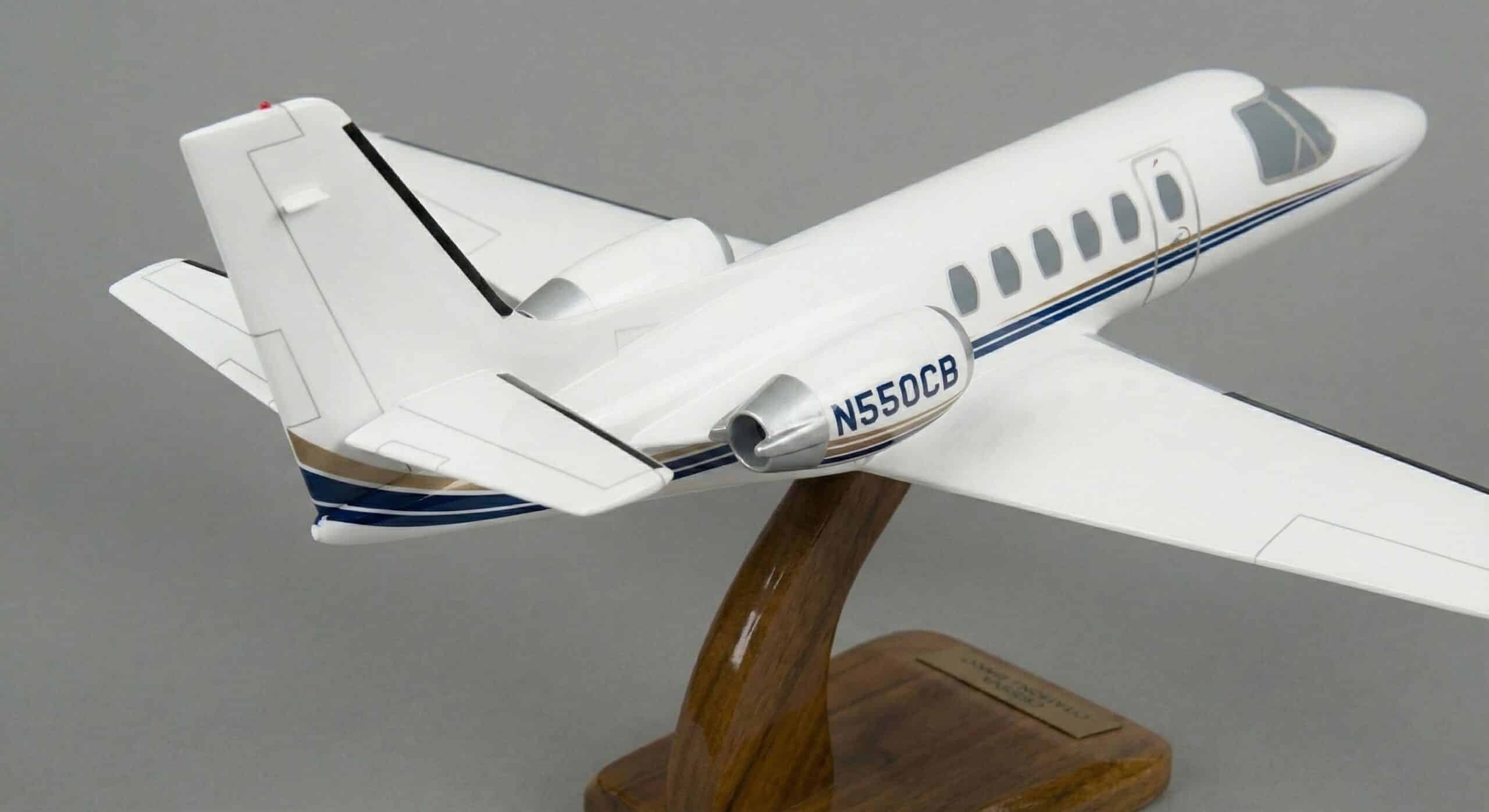
The Citation Bravo has a clean, disciplined geometry. The fuselage proportions are compact yet balanced. The swept tailplane, engine nacelle placement, and cockpit profile form a silhouette that is immediately recognizable to anyone familiar with light jets. That visual restraint is exactly what makes the aircraft model challenging. If the proportions are off by even a small margin, the aircraft no longer reads as a Bravo.
When executed properly, the Cessna 550 Citation Bravo Jet Model carries the same visual logic as the real aircraft. It does not demand attention. It earns it. That quality appeals strongly to pilots, corporate clients, and aviation professionals who value authenticity over exaggeration.
Craftsmanship Rooted in Proportion and Material Discipline
A museum-quality wooden airplane model of the Citation Bravo depends on careful control of proportion, surface transitions, and stance. Wing incidence, nose profile, windshield angle, and engine alignment must all work together or the aircraft loses credibility. Each custom airplane model is developed using detailed reference imagery so the final model plane reads correctly from every viewing angle.
Clients who value traditional materials often request construction approaches involving fine woods such as balsa for internal shaping and mahogany wood for surface refinement. When handled properly, a mahogany wood model carries a depth and permanence that synthetic materials rarely achieve. Clients interested in additional high-fidelity aviation projects can explore our broader range of custom aircraft models, where research accuracy and proportion fidelity guide every build.
Customization That Reflects Real Aircraft and Real Use
Commissions for a Cessna 550 Citation Bravo Jet Model are often highly specific. Owners request replicas of their own aircraft. Corporate clients commission models reflecting fleet liveries for boardroom display. Charter operators request branded aircraft models for client environments. Scale can be adapted to suit private offices, aviation collections, training environments, or institutional display.
Livery details, registration markings, and configuration features can be reproduced when reference material is available. Display bases may be kept architectural and minimal or customized with engraved plaques for commemorative purposes. In each case, the model is shaped around the aircraft’s real identity rather than a generic template.
Who Typically Commissions This Type of Model Plane
The Cessna 550 Citation Bravo Jet Model is most often commissioned by business aviation pilots, aircraft owners, corporate flight departments, charter operators, aviation educators, and serious collectors of modern aircraft. It appeals to those who understand aviation as a profession rather than a spectacle. These are usually thoughtful commissions tied to real aircraft, real careers, and real experience.
Preserving the Legacy of a Professional’s Business Jet
The Citation Bravo earned its reputation quietly, through consistent performance and disciplined engineering. A carefully executed Cessna 550 Citation Bravo Jet Model preserves that legacy in physical form. It stands as a tribute to an aircraft designed not to impress from afar, but to perform reliably day after day in the hands of professionals.
Testimonials

Known & Trusted by