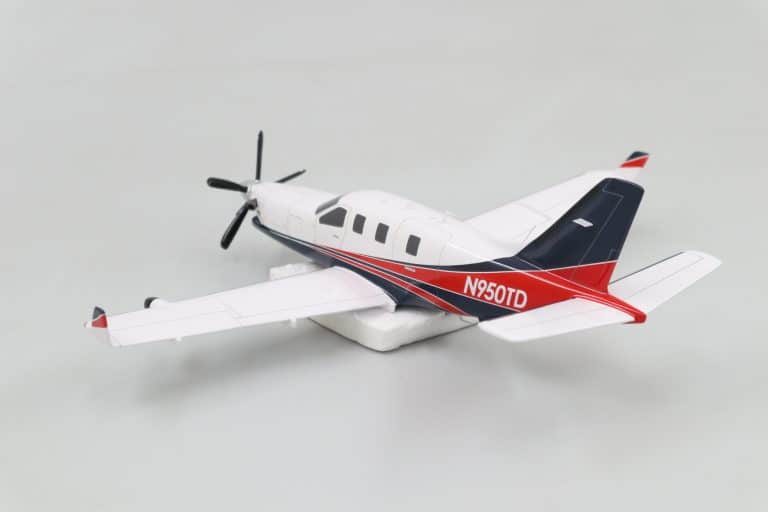
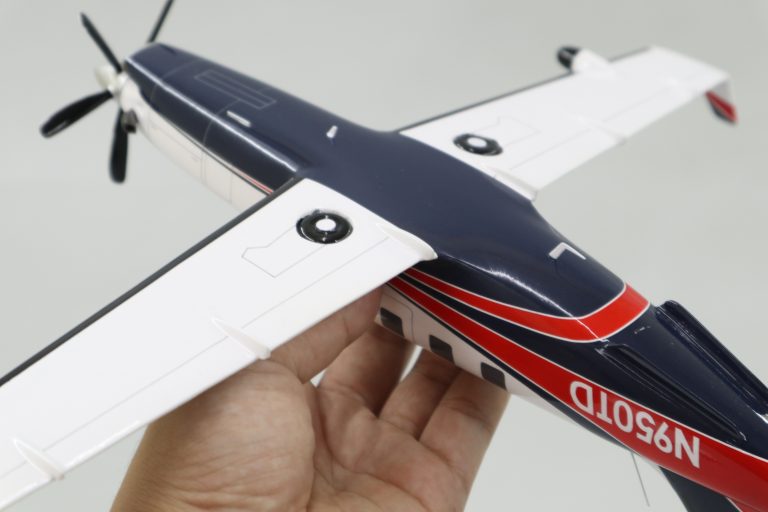
The Socata TBM 900 Airplane Model represents a point where turboprop aviation reached a refined balance between speed, efficiency, and pilot-centric design. By the time the TBM 900 entered service, the TBM lineage had already established itself as a serious alternative to light jets, offering comparable cruise performance with greater operational flexibility. The 900 variant refined that philosophy further, emphasizing aerodynamic cleanliness, systems integration, and disciplined engineering rather than radical redesign.
Aircraft Background and Design Purpose
The TBM 900 was developed as an evolution of earlier TBM models, focusing on drag reduction, noise reduction, and improved overall efficiency. Changes were subtle but deliberate. Aerodynamic refinements to the airframe, including improved engine cowlings and exhaust shaping, reduced parasitic drag and improved cruise performance without increasing pilot workload.
Powered by a Pratt & Whitney Canada PT6A-series engine, the aircraft was capable of high-altitude cruise at speeds that placed it among the fastest single-engine turboprops in the world. Its design supported single-pilot operations while maintaining performance margins suitable for serious business and professional use. Broader technical context on the type can be found through the SOCATA TBM series, which documents the evolution of the platform.
- High-performance single-engine turboprop optimized for speed and efficiency
- Aerodynamic refinements focused on drag and noise reduction
- PT6A turboprop engine supporting high-altitude cruise
- Designed for single-pilot business and personal operations
Why the TBM 900 Matters
The importance of the TBM 900 lies in how convincingly it narrowed the gap between turboprops and light jets. It demonstrated that disciplined aerodynamic optimization and systems integration could deliver jet-like travel times without the complexity and operating costs associated with multi-engine platforms.
For owner-pilots and operators, the aircraft became a benchmark. It rewarded procedural discipline, offered strong climb and cruise performance, and maintained access to shorter runways that jets often could not use.
Scale Representation and Aerodynamic Form
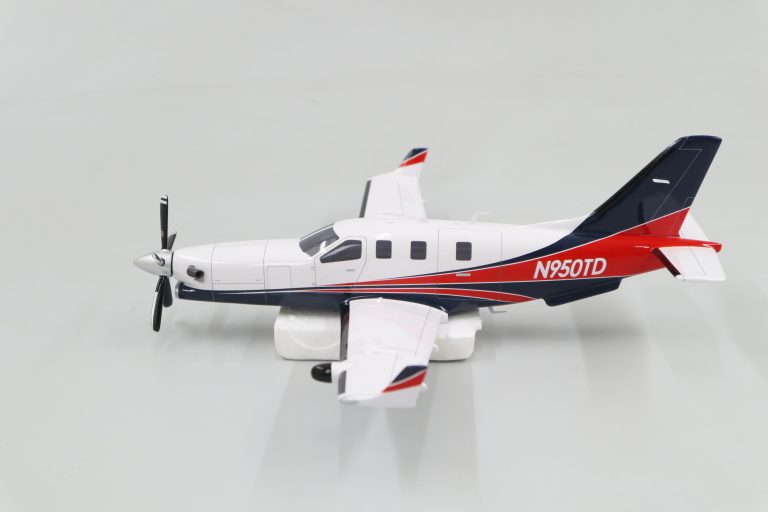
As a scale subject, the Socata TBM 900 Airplane Model demands careful attention to aerodynamic lines and proportion. Its long nose, slender fuselage, and swept vertical tail create a profile that depends on precise alignment. Errors in engine cowling shape, wing taper, or landing gear stance quickly disrupt the aircraft’s visual flow.
- Accurate fuselage length and nose profile
- Correct wing planform and taper geometry
- Faithful turboprop engine cowling proportions
- Landing gear stance reflecting real ground attitude
Craftsmanship and Build Philosophy
Each Socata TBM 900 Airplane Model is built by hand with a focus on dimensional accuracy and surface continuity. Reference materials are used to establish the airframe geometry before any finishing work begins. Particular care is taken to preserve the aircraft’s smooth transitions between fuselage, wing, and tail surfaces.
Detailing remains restrained. Panel lines are subtle, edges are clean, and finishes reflect operational aircraft rather than showroom presentation. The goal is to capture the TBM 900 as it appears in service, flown regularly and maintained with purpose.
Customization and Display Options
The Socata TBM 900 Airplane Model can be customized to represent individual aircraft, corporate ownership, or specific fleet liveries. Scale selection is guided by display environment, while markings and finishes are developed from documented references to ensure accuracy.
- Custom scale selection for office, hangar, or institutional display
- Authentic private or corporate paint schemes
- Registration markings matched to real aircraft
- Display bases with engraved identification plaques
Who Commonly Commissions This Model
This model is commonly commissioned by owner-pilots, corporate flight departments, aviation institutions, and collectors focused on modern performance aircraft. It is also selected by professionals who operate or manage TBM aircraft and value precise physical representations of their fleet.
In every setting, the Socata TBM 900 Airplane Model stands as a representation of efficiency-driven design and the maturity of modern turboprop aviation.
Build My Aircraft Model from Photos

 ❮
❯
❮
❯